Last updated 2026-08-18
TL;DR
Arkansas does not require a state electrical license for temporary power work. You still pull local permits, carry general liability insurance, and follow the 2023 NEC, which the state adopted in May 2024. A basic single-generator setup runs $2,000 to $8,000 all-in. Timeline: 1 to 3 days for permits, 1 to 2 days for setup, under a week for most jobs.
Do you need a license for temp power in Arkansas?
No state electrical license is required for temporary power work in Arkansas. The Arkansas Board of Electrical Examiners regulates electricians doing permanent installations. Temporary wiring for construction, events, or emergency power sits outside that scope, as long as you are not making a permanent installation.
Local rules are a different animal. Some cities, like Little Rock, require a local electrical permit and a master electrician's signature for any wiring over 50 volts [1]. Unincorporated areas and many smaller towns require nothing. Call the building department where the job site sits. Ask one direct question: "Do you require a licensed electrician or permit for temporary power on a construction site?"
The 2023 National Electrical Code (NEC) applies statewide. Article 590 covers temporary installations. Arkansas adopted the 2023 NEC in May 2024 [2]. Your temp setup has to meet NEC 590.6(B) on ground-fault protection and Article 250 on grounding, even when no local permit is pulled.
TempPowerPath's $179 Cable + Fuel + 480V Kit ships pre-built to NEC 590 standards. That does not replace your job of verifying local rules. We publish guides, not legal advice.
What permits do you need for temp power in Arkansas?
Permitting in Arkansas is city-by-city and county-by-county. No statewide temp power permit exists. What you need depends entirely on where the job sits.
In Little Rock, a "Temporary Service" electrical permit costs $50 for the first $500 of valuation, then scales up [1]. In Fort Smith, it's $35 for a temporary service pole inspection [4]. Some rural counties issue permits through the Arkansas Department of Health for special events, roughly $25 for the electrical component of a temporary food booth.
Here's what a typical permit asks for:
- A one-page application with site address and scope
- A simple one-line diagram showing generator, distribution, and loads
- Proof of general liability insurance (usually $500,000 to $1,000,000)
- Fee (most range from $25 to $150)
Turnaround is fast. Most cities issue over the counter today or by email within 1 to 3 business days. Fort Smith has an online portal. Hot Springs wants an in-person visit to the Planning and Development counter.
The hurdle that surprises new operators: if your temp setup feeds a panel that becomes part of the permanent structure, many inspectors treat it as a permanent rough-in and demand a master electrician pull the permit. Keep it physically separate. Freestanding spider boxes, overhead quad cables, no conduit run inside walls.
How much does temp power cost in Arkansas?
A small single-phase setup runs $2,000 to $4,500 all-in: one 5 to 8 kW generator, two spider boxes, 200 feet of cabling, plus permit, fuel, and delivery. A larger three-phase rig for a commercial job site runs $5,000 to $8,000. Those are working numbers, not sticker prices.
Here's a realistic mid-range build for a Little Rock renovation:
| Item | Cost Range |
|---|---|
| 8 kW portable generator (rented, 2 weeks) | $400 to $700 |
| 200 ft #6/4 SOOW cable | $350 to $600 |
| 2 × spider boxes (50A) | $220 to $400 |
| 480V step-down transformer (if needed) | $800 to $2,200 |
| City permit (Little Rock temp service) | $50 to $150 |
| Fuel (gasoline, 50 gallons) | $150 to $200 |
| Delivery/pickup | $80 to $150 |
| General liability insurance (1-month rider) | $100 to $300 |
| Total | $2,150 to $4,500 |
Buy a pre-built kit like the TempPowerPath 480V bundle at $179 one-time, and your recurring cost drops to generator rental, fuel, and permit. That's the cheapest path for repeat jobs. Own the cable and boxes, rent only the generator.
Watch the fuel burn. In Arkansas summer heat, an 8 kW generator under 70% load burns roughly 0.6 gallons per hour. At $3.40 per gallon for gasoline in central Arkansas (August 2024 average per AAA [9]), that's $2.04 an hour. A 10-day job with 8-hour runs adds $163 in fuel alone. Diesel cuts per-hour cost about 30% but costs more to rent. For jobs over two weeks, diesel usually wins.
What insurance do you need for temp power in Arkansas?
No Arkansas statute mandates a specific temp power policy. But every permit office asks for insurance, and every general contractor demands it. Skip it and you don't work.
The floor: general liability covering property damage and bodily injury, $500,000 per occurrence. Most Arkansas GCs require $1,000,000. A one-month rider from a provider like Hiscox or Next runs $100 to $300 depending on your existing coverage.
Read the Classification of Operations line. The policy has to cover electrical work, including hookup of temporary generators and distribution. A standard handyman policy may exclude electrical entirely. You want language like "Electrical Work - Temporary Installations" or at minimum "Construction - Temporary Utilities."
If you rent the generator, the rental company's damage waiver covers physical damage to the unit but not injury or damage the unit causes. That's on your liability policy. Ask the rental yard for a certificate of insurance naming you as an additional insured for the rental period.
Arkansas is a modified comparative fault state (Ark. Code § 16-64-122) [6]. If a court finds you 51% or more at fault after an accident, you recover nothing from the other party. That's why basic liability coverage is non-negotiable, even for a weekend job.
How long does temp power take in Arkansas?
Seven days, door to power on. That's a realistic, slightly padded timeline for a job in a mid-sized Arkansas city like Conway or Bentonville. Here's where the days go:
- Permit (1 to 3 days): Cities with online or counter issuance turn it same day. Mailed paper permits add 7 to 10 days, and almost nobody uses mail for temp permits.
- Equipment rental (1 day): Reserve a generator and cable by phone. Pick up same day or next from United Rentals or Sunbelt in Little Rock, Fayetteville, or Fort Smith. Availability is fine outside natural disaster periods.
- Setup (1 to 2 days): One person can stand up a basic spider box and cabling layout in 4 hours on flat ground. Add a day if you're trenching or running overhead lines that need inspection.
- Inspection (same day, typically): Cities like Springdale and Rogers require a visual inspection before energizing. Call mid-morning, the inspector arrives that afternoon.
From a Monday go-ahead, you're powered by Friday if everything lines up. The thing that kills timelines: the rental yard may not have the specific 480V transformer you need. Call three days ahead and reserve it. The TempPowerPath kit takes that variable off the table for anything 480V and under.
Rural job with no permit requirement? The timeline drops to 2 to 3 days. Pickup, setup, done. No state filing needed.
Which Arkansas cities have the toughest temp power rules?
Little Rock, Fayetteville, and North Little Rock enforce temporary power code harder than anywhere else in the state. Little Rock requires a master electrician's permit for any temporary service over 50 volts connected to a structure [1]. Fayetteville inspectors fail you if your ground rod isn't 8 feet deep and marked with a visible cap. North Little Rock enforces NEC 590.6(B) to the letter: every 15- or 20-amp receptacle on a temporary circuit needs GFCI protection, no exceptions.
Hot Springs is easier on paper but slower in practice. The permit counter closes at noon on Fridays and you have to appear in person. Budget a full weekday morning.
Bentonville and Rogers are the flexible ones. Both accept emailed PDFs of a simple one-line diagram and process temp permits in under 24 hours. Inspectors there see quick-turn commercial build-out all the time.
Jonesboro, Pine Bluff, and Texarkana barely enforce temp power permits. Code still applies, since the NEC is adopted statewide, but a surprise inspection is unlikely unless a neighbor complains about noise or a visible hazard.
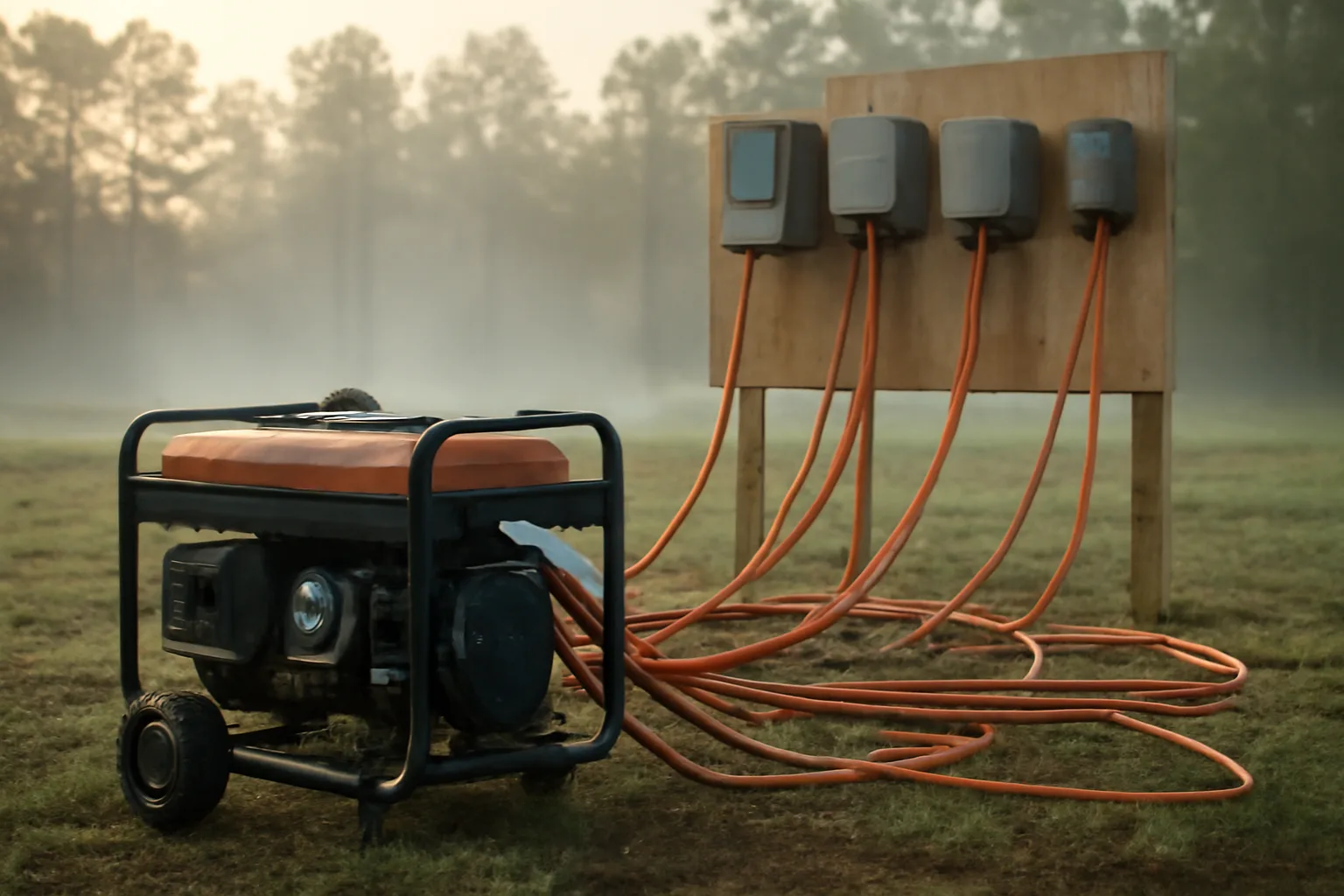
One universal Arkansas rule no city spells out but every inspector enforces: if your temp panel is mounted on a permanent structure, it reads as a permanent install. Use a freestanding plywood backboard or a portable power cart. Keep it 10 feet off any building wall if you want a clean temp classification.
Step-by-step: how to start temp power in Arkansas from zero
Here's the actual sequence a new operator in central Arkansas would run for a typical construction temp setup.
1. Identify the loads. Write down every tool, light, and pump that runs at once. Add 20% headroom. That's your minimum generator wattage. A two-man framing crew with a compressor and microwave needs 5 kW. Add a jobsite trailer with AC and you're at 10 to 12 kW.
2. Choose single-phase or three-phase. Most residential jobs run 120/240V single-phase. Commercial buildings often need 277/480V three-phase for hoists, welders, or HVAC test rigs. Get this wrong and you buy the wrong transformer, adding $800 to $2,200 and two days.
3. Call the local building department. Ask: "What is your temporary electrical permit process?" Do not guess. Write down the fee, required form, and inspection trigger.
4. Book equipment. Reserve the generator, cables, and spider boxes. Specify fuel type. Diesel costs less per hour but more to rent. Gasoline is cheaper upfront. For overnight runs, diesel is quieter and safer.
5. Buy or assemble the hard kit. Cable, boxes, ground rods, and a backboard. A pre-built kit like TempPowerPath's at $179 covers the durable parts, and you add the generator. That saves $300 to $900 over buying pieces at local supply houses.
6. Pull the permit. Submit the application with your diagram. Pay the fee. Get the permit number.
7. Set up. Drive a ground rod within 6 inches of the generator frame per NEC 250.34. Secure SOOW cable at least every 4.5 feet. Put GFCI on every receptacle under 20 amps. Post the one-line diagram in a waterproof sleeve at the main connection point. Not required by code, but it speeds the inspection and cuts re-work.
8. Call for inspection. Don't energize until the inspector signs off, if the city requires it. In unincorporated areas, energize once you verify polarity and grounding with a $25 receptacle tester.
9. Log the start date. For your records and your insurer. A phone photo of the setup, the inspection sticker, and the permit number is enough.
What equipment do you need for temp power in Arkansas?
At minimum, a functional one-generator, two-circuit setup needs:
- Generator (diesel or gasoline, 5 to 15 kW)
- SOOW portable power cable, sized for distance and load (#10/4 for 30A up to 100 feet, #6/4 for 50A up to 200 feet)
- 2 spider boxes (portable outlet centers) with GFCI breakers
- Ground rod (copper-clad, 5/8" × 8 feet) and clamp
- Backboard or portable cart (¾" plywood, 24" × 36", treated) to mount boxes
- Inline GFCI protection if the generator lacks it built in
A three-phase construction trailer setup adds:
- Step-down transformer (480V to 120/240V) rated for the total load
- Cam-lock or pin-and-sleeve connectors (NEMA 3R rated for outdoor)
- Overhead cable support for crossing a roadway (required in many Arkansas cities for anything over a sidewalk; jerry-rigged ladders get red-tagged)
Where to buy: Locke Supply and Graybar both have branches in Little Rock and Fayetteville. For rental, United Rentals (Little Rock, Fayetteville, Fort Smith, Jonesboro) keeps temp power skids in stock. Sunbelt Rentals in North Little Rock rents individually metered power distribution boxes.
One Arkansas-specific tip: buy a heavy-duty tarp and bungee cords. Spring and summer thunderstorms flood a generator air intake in minutes. A tarp rigged 3 feet above the generator, no side contact, keeps water out without choking airflow.
NEC 2023 rules that actually matter for Arkansas temp power
Arkansas adopted the 2023 NEC in May 2024, moving off the 2020 edition [2]. Article 590 governs temporary installations. Here are the sections inspectors cite most in Arkansas:
- 590.6(B) Ground-Fault Protection: All 125-volt, single-phase, 15-, 20-, and 30-ampere receptacle outlets on temporary wiring must have GFCI. No exceptions. One GFCI outlet on the generator does not cover you. You need GFCI protection at every spider box receptacle.
- 590.6(C) Assured Equipment Grounding Conductor Program: You can skip GFCI on 30-amp outlets only if you run a documented AEGC program with daily visual inspections and quarterly continuity tests. Almost no small operator does this right, so GFCI is simpler.
- 250.34 Portable and Vehicle-Mounted Generators: The generator frame is the grounding electrode. Run a separate ground rod, and you bond it to the frame. A common Arkansas violation: driving a ground rod 20 feet away and running bare copper wire above ground. That fails on physical protection and bond integrity.
- 590.3 Time Constraints: Temporary power for construction can stay for the duration of the project. Holiday lighting caps at 90 days. Emergencies run indefinitely but need a permanent replacement plan.
A direct quote from NEC 590.6(B): "All 125-volt, single-phase, 15-, 20-, and 30-ampere receptacle outlets that are not a part of the permanent wiring of the building or structure and that are in use by personnel shall have ground-fault circuit-interrupter protection for personnel." [7] That's the language that fails you if you run a non-GFCI spider box.
Rural Arkansas: no permits, no problem?
Rural Arkansas counties, say Polk, Montgomery, or Stone, often have no building department at all. No permit. No inspection. That is not the same as "do whatever."
The 2023 NEC applies regardless of enforcement. If an accident happens, liability turns on whether you followed the adopted code. Skipping the permit doesn't shield you. It just removes the inspector who might have caught a fault before someone got hurt.
Some rural electric cooperatives, like Ouachita Electric or Entergy Arkansas, set their own hookup requirements for temporary service poles. Connect to a cooperative-owned transformer or meter loop, and the co-op sends a service tech who can refuse to energize a setup that misses their specs. Co-op rules often run stricter than city code: they want a visible disconnect within 50 feet, a weatherproof meter base with bypass, and 200 amps minimum for anything labeled "construction service."
Noise ordinances catch people too. Arkansas has no statewide noise limit, but counties set their own. Saline County caps continuous noise at 60 dB at the property line after 10 p.m. A 10 kW diesel generator runs 70 to 75 dB at 23 feet. Put it behind a barrier (plywood, hay bales, or a rental sound blanket wall) if you're near houses.
The rule for rural Arkansas temp power: build to NEC 590 even when nobody is checking. It's cheaper than a liability claim.
How much can you charge for temp power services in Arkansas?
Rates track market and scope. Small operators running single-gen setups on residential remodels charge $75 to $150 per day plus setup. Commercial jobs with three-phase, transformer, and distribution run $250 to $500 per day.
Market rates seen in 2024:
- Fayetteville/NWA: $125/day for basic single-phase temp power (compressor-grade generator, two spider boxes)
- Little Rock metro: $90 to $110/day competitive range; more utilities here offer temporary service poles with meter at $15/day directly from Entergy, which squeezes private rates
- Jonesboro/rural NE: $150/day; less competition, longer drive times
A typical bid is a flat mobilization ($500 to $800) plus daily ($75 to $150) plus fuel pass-through. A 10-day residential job at $800 mobilization + $100/day + fuel runs about $2,050 total.
Here's what nobody tells new operators: Arkansas general contractors expect the temp power sub to carry their own insurance and name the GC as additional insured. Budget $50 to $75 for a certificate endorsement per job. Don't eat that cost. Build it into the mobilization fee.
The biggest mistakes when starting temp power in Arkansas
1. Assuming a handyman exemption covers electrical. Arkansas has no handyman exemption for electrical hookups. Connect conductors to a building panel and you're doing electrical work. Get a licensed electrician for the final tie-in if the load center is wall-mounted.
2. Undersizing cable. SOOW cable on a 50-amp circuit at 150 feet with #10 wire overheats and trips the generator breaker over and over. A hot-ground fault under load is the most common call we hear about in Arkansas August heat. Run #6/4 minimum for any stretch over 100 feet at 50 amps.
3. No GFCI on spider boxes. The NEC requirement is per receptacle. A GFCI breaker in the generator does nothing for receptacles 200 feet away if the fault sits between them. Put individual GFCI devices at the point of use.
4. Ignoring the fuel plan. Gasoline generators need refueling every 6 to 10 hours under load. An 8 kW unit running a construction trailer with a window AC unit burns 8 to 10 gallons a day. That's daily fuel runs. If the nearest gas station is 20 miles out, put that time and cost in your bid.
5. No written contract. Handshake deals are common in Arkansas. They also leave you exposed when a GC disputes whether temp power was in the original scope. A one-page service order listing equipment, daily rate, fuel terms, and liability clauses takes 10 minutes. Write it before you unload the generator.
How to keep it cheap: the minimum viable temp power setup
Testing the Arkansas temp power market with your own cash? Here's the lowest-cost path that still passes inspection and code:
- Used 5 to 7 kW portable generator with GFCI outlets ($400 to $700 on Facebook Marketplace or Craigslist in central Arkansas)
- 100 feet of #10/4 SOOW cable ($150 at Locke Supply)
- One 4-outlet spider box with built-in GFCI ($110 at Graybar)
- Ground rod kit at Lowe's ($35)
- Temp permit where required ($25 to $75)
- Skip the transformer, skip three-phase, skip the trailer hookup
Total outlay: about $800. On the first 5-day residential job at $100/day, you cover the hardware.
Where this breaks down: a 5 kW generator won't run a jobsite trailer AC unit. It won't run a 480V pump. You're capped at 30 amps continuous, which is fine for lights, chargers, and a small compressor, but not a crew of six with a microwave and a miter saw.
For operators doing this repeatedly, the TempPowerPath $179 Cable + Fuel + 480V Kit fills the gap. It includes the cable, distribution, and transformer-ready components for less than piecemeal. You add the generator. That keeps your per-job hardware cost under $200 after the first use.
The ramp-up math is simple. Spend $2,100 on cable, boxes, and a transformer in month one. After that, each job costs you generator rental, fuel, and permit, roughly $350 a week. Six jobs and the hardware is paid off. That's a typical path.
Do you need a contractor's license for temp power in Arkansas?
Short answer: no, not specifically for temp power. The Arkansas Contractors Licensing Board requires a license for any project over $50,000 total contract value, including residential (Ark. Code § 17-25-101) [8]. If your temp power contract value is under $50,000, no state contractor license is needed.
There are edge cases.
Bundle temp power inside a larger contract over $50,000, say full site prep with power, fencing, and portable toilets, and the total triggers the license requirement. Many operators stay deliberately under that threshold by keeping temp power as a separate contract, not a line item in a bigger GC bid.
Some Arkansas cities also require a local business license to operate within city limits. Little Rock requires a privilege license ($100 annually) for any business with a physical presence or recurring jobs inside city boundaries [5]. Fayetteville has a similar requirement at $75 annually. Neither is temp-power-specific, but if you're pulling permits in a city, they check whether you have a local business license on file.
No Arkansas electrician license is required to own the generator, set up the spider boxes, or plug in tools. The license trigger fires only when you wire into a permanent panel or pull a permanent electrical permit. Keep your temp gear freestanding, cord-and-plug connected, no hardwired pigtails, and you stay outside the license boundary.
Arkansas weather and temp power: what you should know
Arkansas throws three weather realities at temp power operations.
Spring storms (March through May). Tornado watches and sudden high winds are routine. An unsecured generator can go airborne or tip and spill fuel. Anchor it with two 24-inch ground stakes and ratchet straps. Many Arkansas inspectors red-tag a generator sitting loose on bare dirt.
Summer heat (June through August). Ambient temperatures of 95°F with high humidity derate a generator's capacity. At 100°F, a unit rated for 8 kW may deliver only 6.5 to 7 kW before thermal protection trips. Size the generator for maximum load at peak ambient temperature using the manufacturer's derating chart. The 20% headroom rule becomes 35% in Arkansas July.
Flash flooding. A job site in a low spot floods with 2 inches of water in a 30-minute downpour. Circuit and spider boxes at grade go under. Mount them on a backboard at least 18 inches up. NEMA 3R boxes are rain-tight from above but not submersible.
One cheap safeguard: carry a $10 Kill-A-Watt meter. Measure actual load before you commit the generator. "I thought the AC was 12 amps" turns into 18 amps in Arkansas humidity with a dirty condenser coil. A 10-second meter check saves tripped breakers and service calls.
Frequently asked questions
Do I need a state electrical license to provide temp power in Arkansas?
No. The Arkansas Board of Electrical Examiners does not require a license for temporary power work, as long as you are not doing permanent electrical installations. Hardwire into a permanent panel or pull a rough-in electrical permit, and a licensed electrician is required. Keep your temp setup cord-and-plug connected to stay clear of the license boundary. Always verify local city requirements, since some municipalities add restrictions.
How much does a temp power setup cost for a one-week job in Arkansas?
A basic one-week single-phase job with a rented generator costs $2,000 to $4,500 all-in, including equipment, permit, and fuel. If you already own the cabling and distribution gear (like a TempPowerPath kit), the per-job cost drops to $350 to $500, covering only generator rental, fuel, and permit. A larger commercial three-phase job runs $5,000 to $8,000 for the week.
How long does it take to get a temp power permit in Arkansas?
Most Arkansas cities process temp power permit applications over the counter or by email within 1 to 3 business days. Fort Smith offers an online portal with same-day issuance. Cities like Hot Springs require an in-person visit and may take longer. In rural areas with no building department, no permit is needed, but NEC compliance is still required.
What Arkansas cities are most strict on temp power inspections?
Little Rock, Fayetteville, and North Little Rock run the most rigorous temp power inspection programs. They require a permit for anything over 50 volts and routinely enforce NEC GFCI and grounding rules. Bentonville and Rogers are more flexible with one-day turnaround. Rural counties seldom inspect unless a complaint is filed.
Is fuel included in typical temp power rental rates in Arkansas?
No. Generator rental rates cover the machine only. Fuel is always a separate, pass-through cost. At a gasoline price around $3.40 per gallon in central Arkansas, a 10-day job with 8-hour daily runs adds about $163 in fuel. Diesel is more fuel-efficient per hour but has a higher upfront rental cost.
Do I need insurance specifically for temp power work in Arkansas?
No state statute mandates temp power insurance, but any permit office and any general contractor will require general liability insurance with at least $500,000 to $1,000,000 per occurrence. Make sure the policy explicitly covers electrical work and temporary installations. A one-month rider typically costs $100 to $300.
Can I set up temp power on a rural Arkansas job site without a permit?
Yes, many unincorporated areas require no permit. But the 2023 NEC still applies as adopted state code. The local electric cooperative (like Entergy or Ouachita Electric) may set its own interconnection requirements for temp service drops. You are liable for any code violation regardless of permit status.
What is the most common NEC violation on Arkansas temp power jobs?
Missing GFCI protection at spider box receptacles. NEC 590.6(B) requires ground-fault protection on every 15-, 20-, and 30-amp 125-volt receptacle. A GFCI on the generator is not enough if the downstream distribution boxes lack individual protection. This is the most frequent point of failure during inspections in Little Rock and Fayetteville.
Do I need a master electrician to sign off on a temp power permit in Arkansas?
In some cities, like Little Rock, a master electrician's signature is required on a temporary service permit if the wiring exceeds 50 volts. In most other jurisdictions, the property owner or contractor can pull the permit without an electrician's license. Call the specific city building department to confirm before you apply.
What size generator do I need for a typical Arkansas construction trailer?
A 10 to 12 kW generator is the minimum for a single jobsite trailer with a small AC unit, lights, and a microwave. At Arkansas summer temperatures, derate the generator by about 15 to 20%, so a 12 kW unit effectively supplies roughly 10 kW. For trailers with multiple AC units or 240V equipment, a 15 kW or larger generator is necessary.
What are the daily rates for temp power services in Arkansas?
Rates vary by region and scope. Fayetteville/NWA averages $125 per day for basic single-phase service. Competitive Little Rock metro rates run $90 to $110 per day. Rural areas like Jonesboro see $150 per day due to lower competition and longer travel distances. Commercial three-phase jobs command $250 to $500 per day.
How do I ground a portable generator correctly in Arkansas?
NEC 250.34 makes the generator frame the primary grounding electrode. If you drive a separate ground rod, bond it directly to the generator frame with a continuous, protected copper conductor, not run loosely across the ground. A 5/8-inch by 8-foot copper-clad rod driven within 6 inches of the frame is standard practice.
Is there a state-level temp power licensing board in Arkansas?
No. No state board is dedicated to temp power. The Arkansas Board of Electrical Examiners licenses electricians for permanent work but does not regulate temporary power operators. A few larger cities have local permitting requirements, which you can verify at the city's planning department. The Arkansas Contractors Licensing Board only applies if your contract exceeds $50,000 total.
Sources
- City of Little Rock Planning and Development: Little Rock requires an electrical permit for temporary service and lists fees starting at $50 for jobs valued at $500 or less.
- Arkansas Department of Labor and Licensing, Electrical Board (NEC 2023 adoption): Arkansas adopted the 2023 NEC effective May 2024 and Article 590 covers temporary installations including GFCI requirements.
- City of Fort Smith Permitting: Fort Smith charges $35 for a temporary service pole inspection and offers online permit issuance.
- City of Little Rock Treasury: Business License: Little Rock requires an annual privilege (business) license at $100 for any business operating within city limits.
- Arkansas Code § 16-64-122 (Comparative fault): Arkansas is a modified comparative fault state; a party 51% or more at fault cannot recover damages, making liability insurance essential.
- NFPA 70 National Electrical Code (NEC 590.6(B), 2023 edition): NEC 590.6(B) requires GFCI protection on all 125-volt, 15-, 20-, and 30-amp receptacle outlets on temporary wiring.
- Arkansas Contractors Licensing Board (Ark. Code § 17-25-101): Arkansas requires a contractor license for projects exceeding $50,000 total contract value.
- AAA Gas Prices: Arkansas Average August 2024: Average gasoline price in Arkansas was approximately $3.40 per gallon in August 2024, used for operational cost estimates.