Last updated 2026-08-18
TL;DR
Almost all temporary power work in Arizona requires a licensed electrical contractor (C-11 or R-11) plus a local permit. APS and SRP will not connect until the job passes inspection. Costs split three ways: contractor license, local permit, and utility set-up, with the utility side ranging from a few hundred to a few thousand dollars. Timeline is usually one to three weeks, often longer if a new transformer or line extension is needed.
Do you need a license for temp power in arizona?
Yes, almost always. Temporary power installation is electrical contracting, and Arizona law says you need a contractor license from the Arizona Registrar of Contractors to do electrical work for someone else. The relevant license classes are C-11 for commercial electrical work and R-11 for residential electrical work. [1] Acting as a contractor without a license violates ARS 32-1122, and the Registrar can issue a civil penalty that often exceeds the profit on the temp power job. [2]
There is an owner-builder exemption. If you own the property and the project is your own residence, you may pull your own permit under ARS 32-1121, but you cannot hire unlicensed help and you cannot do it for a neighbor or a spec home. [11] Some contractors try to use a friend's license to pull permits. That is illegal, and Arizona has a license display rule that lets inspectors verify the license holder on site.
Local permits are separate from the state license. Even with a state contractor license, you still need a city or county electrical permit for the temporary power pole. Some jurisdictions also require the contractor to register with the city before pulling the permit. Check the city's contractor registration page before you bid.
What is a temp power board in arizona?
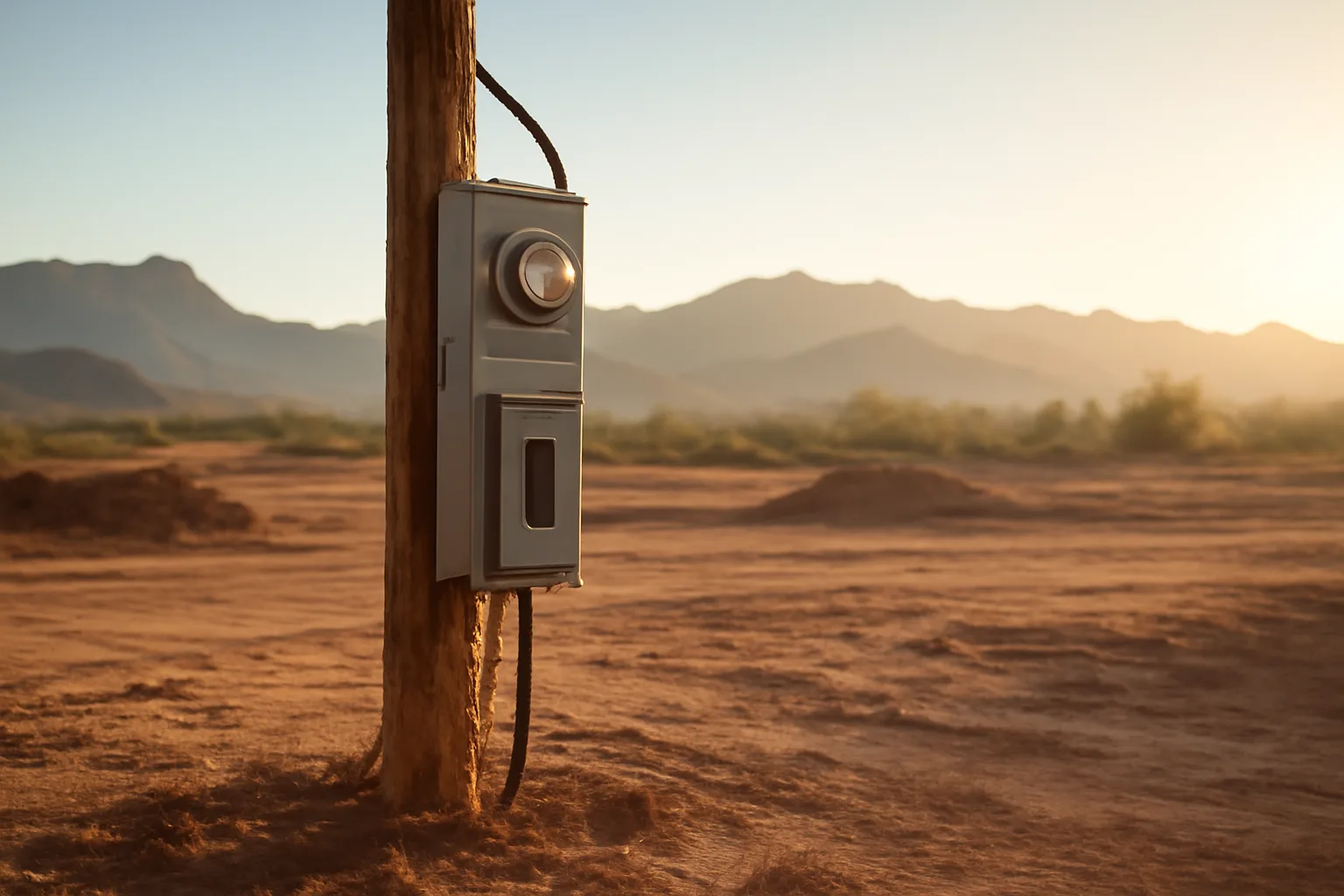
A temp power board is a portable electrical panel used to get power to a site before the permanent service is installed. In Arizona, it usually sits on a temporary pole, with a meter socket, a main breaker, and a few branch circuit breakers feeding GFCI receptacles. The whole assembly is weatherproof, rated NEMA 3R or better, because Arizona job sites see dust, monsoon rain, and direct sun. A board built for indoor use will fail inspection and may create an electrical hazard.
The NEC calls this temporary installation and sets rules for it in Article 590. [6] OSHA has its own construction wiring rules in 29 CFR 1926.405, and they overlap but are not identical. OSHA focuses on worker safety, the NEC focuses on installation safety, and Arizona local codes add the enforcement. [5]
People use the term 'board' loosely. It can mean a factory-built panel like a spider box, or a contractor-assembled board made from a meter main and a small distribution panel. For a utility to connect, the board must have an approved meter socket and a visible main disconnect. APS and SRP each publish a list of approved meter equipment, so check before you buy. [7][8]
How much does temp power cost in arizona?
The honest answer is that temp power cost has three layers, and nobody publishes one flat price. The state contractor license fee is set by ARS 32-1127, and you confirm the current amount with the ROC because the fee schedule changes. [3] Local temporary power pole permits in Arizona cities typically run from about $50 to $200, but Phoenix, Tucson, and unincorporated counties set their own numbers. The only way to get an exact permit fee is to call the local building department and ask for the current fee schedule.
The utility side is the wildcard. APS and SRP both charge for temporary service, and the charge can be a flat set-up fee plus possible line extension costs. A simple temporary meter on an existing transformer may cost a few hundred dollars. A remote rural site with a long line extension can run into thousands. [7][8] Utility costs also depend on whether the temporary service is overhead or underground, and whether you need a transformer.
Here is a rough cost map, with all numbers as ranges to verify:
| Cost component | Typical range | Who sets it |
|---|---|---|
| State contractor license (C-11/R-11) | $200 to $600, confirm current | Arizona Registrar of Contractors [3] |
| Local temp power pole permit | $50 to $200, confirm current | City or county building department |
| Utility temporary service set-up | $100 to $2,000+ | APS or SRP [7][8] |
| Temp power board rental (monthly) | $40 to $150 | Supply houses |
| Temp power board purchase (basic 200A) | $300 to $1,200 | Electrical distributors |
Renting a board is often the cheaper entry point. If you do this often, a simple cable, fuel, and 480V kit from TempPowerPath for $179 covers the distribution end, but you still need the local permit and licensed hookup.
How long does temp power take in arizona?
Plan for at least a week, but do not count on it. The timeline breaks into three independent queues that can run at the same time if you sequence them right. First, if you do not already hold a C-11 or R-11 license, getting one from the Arizona Registrar of Contractors takes weeks, not days, because you need an application, bond, and background check. [2] Second, the local permit for a temporary power pole is often same-day or next-day in small jurisdictions, but Phoenix and Maricopa County can take a few business days if the plan review desk is busy. [9][10] Third, APS and SRP each need an inspection approval before they schedule a meter set. Their builder lines typically quote 5 to 10 business days after inspection, but summer storm season and rural line crews can stretch that. [7][8]
The fastest real-world path is to have your licensed contractor apply for the local permit and utility service in parallel, then get a clean inspection on the first visit. If you need to modify the board, add a ground rod, or correct a GFCI fault, add another day or two. A failed inspection also means rescheduling the utility meter set, which can add a week.
No state statute sets a maximum processing time for temporary power permits. The only hard time limit in this space is the NEC's 90-day limit for non-construction temporary installations, and that does not apply to a construction site. [6] For construction, the clock runs until the project is done.
Do you need a permit for a temporary power pole in arizona?
Yes. Almost every Arizona city and county requires a temporary power pole permit before the utility will connect. The permit is separate from the state contractor license and separate from the utility's own service order. [9][10] In Maricopa County, unincorporated areas use the county's temporary power pole permit process. In Phoenix, it is a simple trade permit through Development Services.
A typical temporary power pole permit application asks for the site address, a simple plan showing pole location, the panel schedule, and a grounding method. Some jurisdictions want a one-line diagram if the board has multiple voltages or a transformer. The permit fee varies. In Phoenix, the city publishes a fee schedule, so confirm the current number before you write the check. Do not assume the fee is the same as last year.
Once the permit is issued, the local inspector will visit. APS and SRP will not energize until the inspection is approved and released, no exceptions. The inspector checks the pole's physical support, the weatherproof enclosure, GFCI protection, grounding, and the main disconnect. A clean inspection is your green light to call the utility for a meter set.
Can a homeowner install temporary power in arizona?
You can, but only on your own property, for your own project, and you will shoulder the full code burden. ARS 32-1121 exempts an owner-builder who is building or improving their own residence, but the exemption does not apply to rental property, spec homes, or work for a friend. [11] The homeowner exemption also does not waive the local permit or the utility's requirements.
Even as an owner-builder, you still need the local permit, and you still need a passing inspection. Most city inspectors will hold your temporary board to the same NEC Article 590 and OSHA 1926.405 standards as a licensed contractor. If you do not know how to size a ground rod, bond a meter socket, or protect 15 and 20 amp receptacles with GFCI, hire a licensed electrician for the first one. The cost of a failed inspection goes beyond the re-inspection fee; it is the days of lost schedule while APS or SRP waits.
If you are a homeowner doing a one-time remodel, many licensed electricians will assemble and connect a temp power board for a few hundred dollars plus the utility fee. That is often cheaper than buying the board yourself and fixing your own mistakes.
What does APS require for a temporary service in arizona?
APS wants three things: a completed temporary service application, a meter socket that meets APS standards, and a release from the local inspection authority. The meter socket must be listed for temporary service and mounted at the height APS specifies. [7] APS also requires that the temporary service be removed when the permanent service is ready.
You do not need to own the property to apply, but you do need the site address and a contact who will be on site for the meter set. APS will also check transformer capacity. If the site is outside an existing service area or needs a new transformer, the time and cost go up. Some rural APS sites require a line extension agreement before the temp service order is accepted.
A common mistake is building a temp board with a meter socket that is not on APS's approved list. That gets you a failed inspection before you even start. Call the APS builder line or check the temporary service page before you buy or rent. The same applies to the height of the meter and the location of the main disconnect.
What does SRP require for temporary construction power?
SRP's process is similar but has its own forms. You request temporary construction power, SRP reviews the site for existing service capacity, and you schedule an inspection with your local jurisdiction. SRP's temporary power page describes the sequence. [8]
SRP service territory covers much of the Phoenix metro, including Tempe, Scottsdale, and Mesa. If your site is in SRP territory but you call APS, you will lose days. Check the utility map before you apply. The two utilities do not share a temporary service application, and neither will energize a meter socket that belongs to the other side.
SRP may require a temporary service with a meter socket that can later be converted or removed. The board itself does not need to be permanent, but it must have a visible main breaker and proper grounding. No utility in Arizona will connect a board that lacks a main disconnect. SRP also has specific requirements for the temporary pole's bracing, so read their handout before you dig the hole.
What are the most common code violations for temp power in arizona?
The most common one is missing GFCI protection. OSHA's rule says, word for word, "All 120-volt, single-phase, 15- and 20-ampere receptacle outlets on construction sites, used for temporary power, shall have approved ground-fault circuit interrupters for personnel protection." [5] NEC Article 590 has the same rule for temporary installations, and local inspectors enforce it. [6] A single unprotected receptacle will fail the whole temporary board.
Other frequent fails: no weatherproof enclosure, no main breaker, unsupported cable, missing ground rod or ground-fault current path, and using a permanent panel rated for indoor use outdoors. In Arizona, dust and monsoon rain make weatherproofing non-negotiable. An inspector will open the deadfront and look at the wiring, so do not hide anything. They also check that the pole is set deep enough to stay upright in wind.
If your board has 240-volt or 480-volt circuits, label them. Missing labels are a common correction notice. It is a cheap fix, but it costs a re-inspection and another week of waiting for the utility. Use a label maker, not masking tape.
Should you rent or buy a temp power board in arizona?
For a one-time project, rent. A good rental panel comes already built, already listed, and already inspected by the rental company's shop. You avoid the capital cost and the storage. In Arizona, many electrical supply houses rent basic 200 amp temporary boards by the month, and they will deliver to the Phoenix and Tucson metros.
For repeated jobs, buy or build a simple board if you are a licensed contractor. The buy-in is low for a basic 200 amp meter main with a few GFCI receptacles. You can add camlock or twist-lock connectors for 30 and 50 amp loads. If you do not need 480 volt, skip it. A $179 cable, fuel, and 480V kit from TempPowerPath covers the distribution end when you already have the meter main and breakers, but it does not include the permit or the utility hookup.
For a comparison of how other states handle the board itself, see temp power board in California or temp power board in Colorado. If you are working near the Alabama line, the Alabama temp power board guide has a different set of utility names.
What does a temp power board package include in arizona?
A complete board for Arizona should include a 200 amp meter main, a main breaker, four to eight spaces for branch breakers, GFCI protected 15 and 20 amp receptacles, and a weatherproof NEMA 3R enclosure. Add a ground bar and a driven ground rod. If you plan to run 240 volt equipment, include a 30 or 50 amp twist-lock receptacle. A 480 volt board adds a transformer and camlock connectors, and most of the time that is overkill for a residential or small commercial site.
The exact configuration depends on what you are powering. A framing crew needs only a few 20 amp circuits. A food truck rally or film shoot might need 480 volt camlocks and a transformer. Match the board to the load, not to the sales sheet. Overbuying a board just adds weight, cost, and code complexity.
Some suppliers sell a package that includes cable, connectors, and a board. That can save time, but verify the meter socket is on the utility's approved list before you spend. APS and SRP both publish approved meter list. [7][8] Also check that the board's enclosure is rated for outdoor use in Arizona; an indoor NEMA 1 panel will not survive one summer.
Arizona temp power board vs permanent service: what changes?
Temp power uses temporary installation rules. NEC Article 590 applies during construction, remodeling, maintenance, or repair, and it requires removal when the project is done. [6] Permanent service uses the regular chapters of the NEC and requires full plan review, a final inspection, and a different utility process. You do not want to install a permanent panel and call it temporary, because the inspector will catch it.
One important line: non-construction temporary installations, like holiday lighting or a carnival, have a 90-day limit under NEC 590.3(B). Construction temp power does not have that 90-day cap, but you still remove it at the end of the project. [6] The 90-day limit is real and applies to things like a temporary event power board that feeds a stage or a vendor tent.
The meter socket and panel may look similar, but the permitting path is different. A temp board can often be moved between jobs if it stays in good shape. A permanent panel stays with the building. For a state-specific look at another path, see temp power board in Florida.
Where do you find the current arizona temp power rules?
Start with the Arizona Registrar of Contractors for license status and fee schedules. Then go to your city or county building department for the temporary power pole permit. Finally, call APS or SRP with the site address and ask for the temporary service desk. [2][3][7][8]
Do not rely on a national article or a YouTube video from another state. Arizona's split between APS and SRP, plus local amendments to the NEC, means the real answer lives in three places. For a neighboring state's paper path, see temp power board in Georgia or temp power board in Connecticut.
No approval or timing guarantee exists. Everything here is confirm with the relevant board, the local building official, and the utility. The fees and timelines change, and the only person who can approve your board is the inspector standing on your job site.
Frequently asked questions
Do you need a license for temp power in Arizona?
Yes, almost always. You or your contractor needs a C-11 or R-11 license from the Arizona Registrar of Contractors. ARS 32-1122 makes unlicensed contracting unlawful. A homeowner doing work on their own residence may qualify for an owner-builder exemption under ARS 32-1121. Local permits remain separate.
How much does temp power cost in Arizona?
Cost has three parts. The state contractor license fee is set by ARS 32-1127; confirm current amount with ROC. Local temp power pole permits usually run $50 to $200. Utility temporary service set-up from APS or SRP can be $100 to over $2,000 depending on line extension. A board rental runs $40 to $150 a month.
How long does temp power take in Arizona?
Plan for a week to several weeks. Local permits can be same-day, but Phoenix and Maricopa County may take a few business days. APS and SRP typically quote 5 to 10 business days after inspection to set a meter. Getting a contractor license from scratch adds weeks. No state maximum exists.
Can I use a generator instead of a temp power board?
Yes, a generator is a legitimate temp power source, but it does not eliminate the permit or inspection if you are connecting it to a structure. A generator feeding a temporary board with a transfer switch still needs a local electrical permit. For simple portable tools, a generator with built-in GFCI often skips the board entirely.
What is the difference between a temp power pole and a spider box?
A temp power pole is the whole assembly: pole, meter socket, main breaker, and outlets. A spider box is a portable distribution panel that plugs into a larger temporary service or generator. You often use a spider box to split one 50 amp circuit into four or more GFCI protected 20 amp circuits.
Do I need a separate permit for each temp power board on the same site?
Usually no, if the boards are on the same site and the original permit covers the total temporary electrical scope. But bigger sites with multiple panels or different voltages may need a revised set of plans. Check with the local inspector. The utility only cares about the meter socket, not how many boards hang off it.
How do I find out if my site is APS or SRP?
Both APS and SRP publish service territory maps. A quick call to either with the street address will tell you. Do not guess; each utility has a different application and different meter requirements. The wrong call costs you days. The maps are on their websites under service area or building services.
What is the penalty for doing unlicensed temp power work in Arizona?
The Arizona Registrar of Contractors can issue civil penalties, and a court can add criminal charges for repeated or fraudulent unlicensed contracting. Penalties often run from $1,000 to $5,000 per violation, plus possible restitution. ARS 32-1122 and the ROC's penalty schedule set the framework. This is not a small risk.
Can I run a temp power board from an existing building's panel?
Yes, you can backfeed a temporary board from an existing building's panel if the panel has spare breaker space and the temporary board has a main breaker. You still need a local electrical permit, and the circuit must be GFCI protected at the source or at each receptacle. The utility does not get involved if no new meter is needed.
What size ground rod does a temp power board need in Arizona?
NEC 250.52 requires a ground rod at least 8 feet long in contact with the soil. Most Arizona inspectors want two rods spaced at least 6 feet apart unless you can prove resistance under 25 ohms. The exact rule is in the adopted NEC edition, so check the local amendment. A single 8 foot rod is the minimum.
Do I need an inspection before APS or SRP connects?
Yes. APS and SRP will not set a temporary meter until the local building inspector has signed off and released the permit in the utility's system. The inspection checks GFCI, weatherproofing, grounding, and main disconnect. Do not schedule the utility until the inspector has actually passed the board.
How do I convert temp power to permanent service?
You remove the temp board and temp pole, then file a permanent service application with the utility and a final electrical permit with the local jurisdiction. The permanent panel gets a different inspection. Some contractors reuse the same meter socket if it is listed for permanent use, but most replace it. The utility will not energize permanent service without a final inspection.
Sources
- Arizona Revised Statutes § 32-1101: Defines contractor license classes C-11 and R-11.
- Arizona Revised Statutes § 32-1122: Requires contractor license, prohibits unlicensed contracting, sets exceptions.
- Arizona Revised Statutes § 32-1127: Sets contractor license application and renewal fees.
- Arizona Revised Statutes § 32-1123: Contractor license term and renewal period is two years.
- OSHA 29 CFR 1926.405: Temporary wiring and GFCI requirements on construction sites, including the quoted GFCI rule.
- NFPA 70, National Electrical Code, Article 590: Temporary installation rules, 90-day limit for non-construction temporary installations.
- Salt River Project (SRP), Temporary Construction Power: SRP temporary construction power process and requirements.
- Maricopa County, Planning and Development, Temporary Power Pole: Maricopa County unincorporated areas require temporary power pole permit.
- Arizona Revised Statutes § 32-1121: Owner-builder exemption from contractor licensing.