Last updated 2026-08-18
TL;DR
Starting temp power in Tennessee means holding a state electrical contractor license (or working under one), pulling a permit for any temporary service, and coordinating with the local utility for meter sets. Typical generator rental jobs run $500 to $3,000 per week depending on size. Permit timelines vary by jurisdiction, usually 1 to 10 business days. Confirm current fees with the Tennessee Department of Commerce and Insurance.
What is temp power in Tennessee and who uses it?
Temp power is any temporary electrical service set up to supply a job site, event, or location before permanent power is available or when permanent power is shut down. In Tennessee, contractors use it on new construction sites to run tools before the permanent service is energized. Event producers use it for outdoor festivals. Disaster recovery crews use it when a storm knocks out utility service to a hospital or shelter.
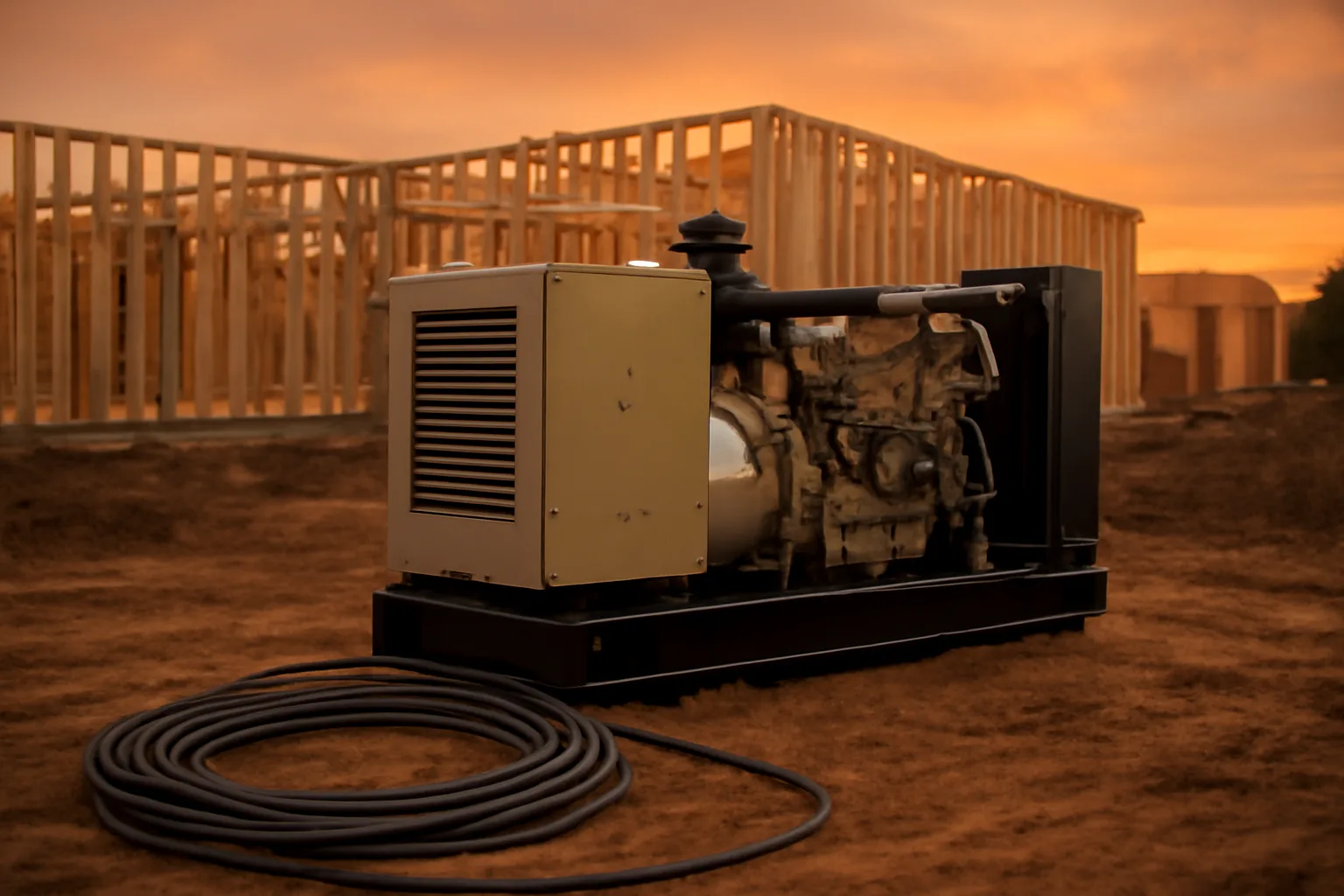
The equipment covers a lot of ground: towable diesel generators from 20 kW up to 2,000 kW, temporary distribution panels, spider boxes, feeder cables, and step-down transformers for 120/240V loads off a 480V three-phase source. The bigger the load, the more paperwork and coordination you need before the first generator starts.
Tennessee has no single unified temp power statute. Instead, the work sits under the state electrical contractor licensing law, local permit requirements from the jurisdiction where the job is located, and utility interconnection rules from the serving utility (TVA territory covers most of the state, with municipal utilities and co-ops covering the rest) [1]. That layered structure is where most first-timers get tripped up.
Do you need a license for temp power in Tennessee?
Yes. Anyone who installs, connects, or maintains electrical wiring or equipment for compensation in Tennessee must hold a license issued by the Tennessee Department of Commerce and Insurance (TDCI), Electrical Contracting Board [2]. That includes temporary electrical installations. There is no carve-out that says "generator rentals don't count" or "it's fine if it's just a plug."
The relevant license types under Tennessee Code Annotated (TCA) 62-6-Part 2 are:
| License Type | Scope | Who holds it |
|---|---|---|
| Master Electrician | Unlimited electrical work, can pull permits | Individual person |
| Electrical Contractor (C-2) | Company license, required to do work as a business | Business entity |
| Journeyman Electrician | Works under master supervision | Individual person |
| Limited Licensed Electrician | Restricted scope, set by board | Individual person |
For a company that rents and connects generators, the business needs a C-2 Electrical Contractor license. That license requires at least one qualifying party who holds a Master Electrician license [9]. The master electrician is the person legally responsible for the installation.
If you're just delivering a generator and the customer's own licensed electrician handles all the connections, you may not need an electrical license yourself. But the moment your crew touches the load-side connections, feeder cables, or transfer switch, you're doing electrical work and the license requirement applies. When in doubt, call the TDCI Electrical Contracting Board directly at (615) 741-2241 before you bid the job.
Tennessee does not have a specialty "temp power" or "generator" license category. The full electrical contractor credential is what the law requires [9].
What exam and experience does Tennessee require before licensing?
The Master Electrician license is the credential that unlocks a C-2 contractor company license. To sit for the Master exam, Tennessee requires documentation of at least 8,000 hours of on-the-job electrical work experience (roughly four years full-time), which must include time as a Journeyman [9]. The experience is verified through affidavits from employers or supervisors.
The exam itself is administered by PSI Exams under contract with the TDCI [8]. As of the most recent published fee schedule, the exam fee is in the range of $95 to $130. Confirm the exact amount directly with PSI or the TDCI before you register, because fees change.
Once you pass the Master exam, the company C-2 license application goes to the TDCI Electrical Contracting Board. The application requires proof of liability insurance, workers' compensation coverage (or a documented exemption), the qualifying Master's license number, and the application fee. Current application fees are listed on the TDCI website, and the board asks you to confirm them before submitting, since the legislature can adjust them [2].
Reciprocity: Tennessee has limited reciprocity with some neighboring states for master electrician credentials. If you hold a current master license from another state, contact the board before sitting for the exam. The board reviews reciprocity requests case by case.
How much does temp power cost in Tennessee?
Cost breaks into three buckets: equipment rental, labor and permit fees, and fuel. None of these have statewide fixed rates. They vary by generator size, rental duration, location, and the contractor doing the work.
Generator rental rates in Tennessee generally track national market rates from companies like United Rentals, Sunbelt, and regional independents. Rough ranges based on commonly published rate sheets:
| Generator Size | Daily Rate (approx.) | Weekly Rate (approx.) |
|---|---|---|
| 20-40 kW (small site) | $175 to $350 | $500 to $900 |
| 60-100 kW (medium site) | $300 to $600 | $850 to $1,600 |
| 150-250 kW (large site) | $600 to $1,200 | $1,800 to $3,200 |
| 500 kW and above | $1,500+ | $4,500+ |
These are rough market ranges, not guaranteed quotes. Fuel is almost always charged separately, either as a consumption rate or a daily fuel surcharge. A 100 kW diesel generator running at 75% load burns roughly 7 gallons per hour [3]. At current Tennessee diesel prices (check the EIA weekly retail report for current figures), that adds up fast on long events [7].
Permit fees are set by each local jurisdiction, not the state. Nashville/Metro Davidson County, Shelby County (Memphis), Knox County, and Hamilton County (Chattanooga) all have their own fee schedules. Most temporary service permits run $50 to $300 for residential or light commercial work, with commercial and industrial fees scaling with the estimated job value or square footage [4]. Always call the local building department for the current fee before you put numbers in a proposal.
Labor to set up a temporary distribution system for a large event or construction site can run $1,500 to $8,000 depending on the complexity of the feeder runs, number of panels, and hours on site. This is not a commodity service. A licensed master electrician who specializes in generator work knows things a general electrician may not, and that knowledge is worth paying for.
For operators who want to understand the cable, fuel, and 480V distribution components before buying, TempPowerPath's $179 Cable + Fuel + 480V Kit covers that piece of the puzzle. Budget planning and permit fees are separate and depend entirely on your jurisdiction. See /start for details on the kit.
How long does temp power take in Tennessee?
Timeline depends heavily on which county or city you're in and what size installation you're doing.
For a simple temporary construction service (a meter base and a temporary panel on a stick), most Tennessee jurisdictions that accept online permits can turn around an approval in 1 to 5 business days. If you're in a smaller county with a part-time inspection staff, that same permit might take 7 to 10 business days or require a phone call to schedule.
For larger temporary installations, say a 480V three-phase temporary service for a major event or a generator paralleling setup at a data center during a planned outage, expect longer. The local electrical inspector may want to review single-line diagrams. The utility may need to coordinate a temporary meter set or a disconnect. In TVA-served territories, the local power company (LES, Memphis Light Gas and Water, NES, EPB, etc.) sets its own service connection timelines, which can add 3 to 10 business days for a meter-based temporary service [1].
In practice, the steps and their typical timelines look like this:
| Step | Who does it | Typical time |
|---|---|---|
| Pull permit | Licensed contractor | 1 to 10 business days |
| Set equipment, wire distribution | Licensed electrical crew | Half day to 3 days |
| Rough-in inspection | Local inspector | 1 to 3 business days after request |
| Utility meter set (if needed) | Local utility | 3 to 10 business days |
| Final inspection and sign-off | Local inspector | 1 to 3 business days |
The permit and the utility coordination run in parallel for experienced contractors. If you wait until after the permit is approved to call the utility, you add a week or more. Start both calls on day one.
Nothing in this article is a guarantee of approval time. Jurisdictions change staffing, adopt online portals, or hit backlogs during storm recovery season. Confirm with your specific jurisdiction before you set a client's go-live date.
What permits do you need for temp power in Tennessee?
Tennessee requires an electrical permit for all electrical work, with very limited exceptions for like-for-like repairs [4]. A temporary service installation is not one of the exceptions. You need a permit.
Per TCA 68-120-101 and the Tennessee State Minimum Standard Building Code, local jurisdictions administer electrical permits through their building department or codes enforcement office [4]. The state does not issue permits directly for most residential and commercial work. Industrial facilities may have additional state oversight through TDCI's Construction Services division depending on project scope.
What you submit for a permit varies. At minimum, most Tennessee jurisdictions want:
- Contractor's license number (C-2 electrical contractor)
- Description of the work ("temporary 200A single-phase service for construction site" or similar)
- Site address
- Permit fee
Larger or more complex jobs (three-phase temporary services, paralleled generators, temporary services for events with public attendance) often require a single-line electrical diagram signed by the qualifying master electrician, and sometimes by a licensed engineer depending on the jurisdiction and the load size.
Some Tennessee cities, including Nashville Metro and Knoxville, have moved substantially to online permit applications. Others still require in-person submissions. Check the specific jurisdiction's codes or building department website before you assume online submission is available.
How does utility coordination work in Tennessee for temp power?
Most of Tennessee sits in TVA's wholesale power territory, but retail service is delivered by local distributors: Nashville Electric Service (NES), Memphis Light Gas and Water (MLGW), Knoxville Utilities Board (KUB), Electric Power Board of Chattanooga (EPB), and about 150 smaller municipal utilities and electric cooperatives [1].
Each of those utilities sets its own rules for temporary service connections. If your temp power installation needs a utility meter (for a construction site pulling from the grid rather than running purely on a generator), you coordinate with the serving utility directly, not with TVA [10].
For a generator-only installation where the generator is the sole power source and there's no utility interconnection, you typically don't need to call the utility at all. You still need the permit and inspections, but the utility coordination step drops out.
For a hybrid setup, where a generator parallels with or switches over to utility power via a transfer switch, the utility will want to see the transfer switch arrangement to confirm there's no possibility of back-feeding the utility line. This protects utility workers. Automatic transfer switches (ATS) with proper open-transition sequencing are the standard solution, and most utilities in Tennessee will want to see documentation that the ATS meets their interconnection requirements before they'll set a meter [1].
If you're in an area served by a rural electric cooperative, call them early. Co-op interconnection staff are sometimes one or two people, and their review timelines can be longer than a larger municipal utility.
What insurance does a temp power contractor need in Tennessee?
The TDCI Electrical Contracting Board requires proof of general liability insurance as a condition of holding a C-2 license. The minimum coverage amounts are set by the board and can change. As of the most recently published board rules, the minimum is $300,000 per occurrence for general liability, but confirm current minimums with the TDCI before your application because these figures are subject to revision [2].
Workers' compensation insurance is required for any electrical contractor with employees under TCA 50-6-901 [5]. A sole proprietor with no employees may qualify for an exemption, but the board requires documentation of that status. If you have even one W-2 employee working on job sites, workers' comp is mandatory.
Beyond the license minimums, customers running large events or construction projects will routinely ask for $1 million per occurrence or $2 million aggregate on your certificate of insurance. Budget for the higher limit if you want to compete for those jobs. You'll also see requests for additional insured endorsements naming the project owner.
General liability for an electrical contractor in Tennessee typically runs $2,000 to $6,000 per year depending on payroll, revenue, and claims history. Workers' comp rates vary by job classification. These are rough market ranges, not quotes.
What equipment do you actually need to run a temp power job in Tennessee?
The core equipment list for a typical construction site or event temp power setup:
- Diesel generator (size to roughly 80% of expected peak load, not 100%, to leave headroom)
- Automatic or manual transfer switch (required if utility grid is also a source)
- Temporary distribution panel or power distribution unit (PDU)
- Feeder cables: typically 4/0 aluminum or 2/0 copper for runs up to 100 feet at 100+ amps, with heavier gauge or parallel runs for longer distances
- Spider boxes and portable outlet stations for 120/240V loads at events
- Grounding equipment: ground rods, ground wire, and clamps per NEC Article 250 [6]
- Fuel storage (secondary containment may be required by the local fire marshal above certain quantities)
- Fuel consumption tracking if the job is billed on a fuel-used basis
NEC 2020, which Tennessee adopted with the 2020 cycle, governs the electrical installation standards [6]. Article 590 specifically covers temporary installations and sets requirements for GFCI protection on 120V receptacles, the duration limits for temporary wiring (generally 90 days for construction work), and equipment condition standards.
For operators building out their first setup or expanding into 480V three-phase distribution, understanding how to size cables, calculate voltage drop over longer feeder runs, and match the generator output to the distribution equipment is the part of the job where mistakes get expensive. That's the technical foundation the TempPowerPath Cable + Fuel + 480V Kit is designed to address.
For a deeper look at how neighboring states compare on equipment and licensing requirements, how to start temp power in Alabama and how to start temp power in Arkansas both cover similar licensing structures in the Southeast.
How does Tennessee's electrical licensing compare to neighboring states?
Tennessee's structure, a state-level master electrician exam plus a company C-2 license, is roughly mid-tier in strictness among its neighbors. Here's a quick comparison:
| State | State Contractor License Required? | Reciprocity with TN? | Local Permits? |
|---|---|---|---|
| Tennessee | Yes (C-2 + Master) | Case by case | Yes |
| Alabama | Yes (State Licensing Board) | Limited | Yes |
| Georgia | Yes (State Electrical Board) | Limited | Yes |
| Kentucky | Yes (State Board) | Limited | Yes |
| North Carolina | Yes (Electrical Contractors Board) | Limited | Yes |
| Virginia | Yes (DPOR) | Limited | Yes |
Every Southeastern state requires a state-level license for electrical contracting work. There is no Southeastern state where you can legally do temp power connection work as a business without a contractor license. The variation is in how each state handles reciprocity, continuing education requirements, and which exam provider they use.
If you're already licensed in Alabama and want to do work in Tennessee, contact the TDCI Electrical Contracting Board before starting any jobs. Don't assume the Alabama credential transfers. More detail on neighboring state requirements is at how to start temp power in Alabama, how to start temp power in Arkansas, and how to start temp power in Georgia.
What are the most common mistakes when starting temp power in Tennessee?
A few patterns show up over and over.
Skipping the permit because it's "just temporary." The NEC and Tennessee law do not have a minimum duration below which you don't need a permit. A one-day generator hookup for a festival still needs a permit if your crew is making the electrical connections. Inspectors do show up at events.
Undersizing the generator to win the bid. A 100 kW generator bid at $800/week beats a 150 kW unit at $1,100/week on paper. It loses badly when the load peaks at 110 kW and everything shuts down at the worst possible moment. Size to 80% of anticipated peak, not 100%. This is a firm rule of thumb in the industry, not a guaranteed formula.
Ignoring fuel logistics. On a multi-day event or a construction site running through winter, fuel delivery schedules matter as much as the generator. Tennessee has plenty of diesel suppliers, but scheduling a delivery to a remote job site in Carter County or a festival in Roane County takes more lead time than a Nashville industrial park.
Assuming the utility will move fast. NES, KUB, and EPB are competent utilities with good response times by national standards. But a temporary meter set still takes days, not hours. If your client's schedule has no float, coordinate with the utility before the permit is even approved.
Not confirming the license type covers the work. If you hold only a Journeyman license, you cannot legally serve as the qualifier for a contracting company. Someone with a valid Tennessee Master license has to be on the paperwork.
Where do you go to apply for a Tennessee electrical contractor license?
The Tennessee Department of Commerce and Insurance, Electrical Contracting Board, is the licensing authority [2]. Their main application portal is through the TDCI website. As of 2025, Tennessee uses an online application system for most license types.
The address for the board: Tennessee Department of Commerce and Insurance Electrical Contracting Board 500 James Robertson Pkwy Nashville, TN 37243 Phone: (615) 741-2241
The PSI Exams portal (psiexams.com) handles exam scheduling for the Master Electrician exam [8]. You register there after the board approves your experience documentation.
For continuing education: Tennessee requires 8 hours of continuing education per renewal period for licensed electrical contractors. The board maintains a list of approved CE providers [2]. This requirement is easy to overlook in the first year when you're focused on getting the initial license, but the renewal won't go through without it.
If you want to compare how another state's process looks end-to-end before deciding where to base your operation, how to start temp power in Colorado and how to start temp power in California both have fully documented processes with different licensing structures worth understanding.
Frequently asked questions
Do you need a license for temp power in Tennessee?
Yes. Any company that installs, connects, or maintains temporary electrical equipment for compensation in Tennessee must hold a C-2 Electrical Contractor license from the TDCI Electrical Contracting Board. That license requires a qualifying Master Electrician. If you only deliver and fuel the generator without touching the electrical connections, you may not need the electrical license, but confirm that interpretation with the board before you operate.
How much does temp power cost in Tennessee?
Generator rental alone typically runs $500 to $3,200 per week depending on size, ranging from a small 20-40 kW unit to a 150-250 kW three-phase machine. Fuel is extra: a 100 kW diesel unit at 75% load burns roughly 7 gallons per hour. Permit fees range from $50 to $300 or more depending on the jurisdiction. Labor for setup adds $1,500 to $8,000 for complex multi-panel installations. Get a line-item quote for every project.
How long does temp power take in Tennessee?
Permit approval takes 1 to 10 business days depending on the jurisdiction and whether they accept online submissions. If a utility meter set is needed, add 3 to 10 business days for the serving utility to connect. Physical equipment setup runs half a day to 3 days. Inspections typically take 1 to 3 business days after the request. Start the permit and utility call on the same day to avoid stacking those waits sequentially.
Can I use my Alabama electrical contractor license to do temp power work in Tennessee?
Not automatically. Tennessee's Electrical Contracting Board reviews reciprocity requests case by case. You must contact the TDCI before starting any work in Tennessee under an out-of-state license. Don't assume your Alabama credential transfers. The board contact is (615) 741-2241. For Alabama licensing detail, see how to start temp power in Alabama.
Does TVA regulate temp power installations in Tennessee?
TVA sets wholesale power rates and regional grid policy, but it doesn't directly regulate individual temp power installations or issue electrical contractor licenses. Retail temp power coordination goes through the local distributing utility (NES, KUB, EPB, MLGW, or one of roughly 150 co-ops and municipal utilities). Contact your specific serving utility for meter set and interconnection requirements, not TVA directly.
What NEC code does Tennessee use for temporary electrical installations?
Tennessee has adopted the 2020 National Electrical Code. NEC Article 590 covers temporary installations specifically, including GFCI requirements on 120V receptacles, the 90-day duration limit for construction temporary wiring, and equipment condition standards. Local jurisdictions may have amendments, so check with the specific city or county building department for any local modifications to the 2020 NEC.
How much general liability insurance does a Tennessee electrical contractor need?
The TDCI Electrical Contracting Board requires proof of general liability insurance for C-2 licensure. Minimum coverage amounts are set by the board and are subject to change; confirm current minimums directly with the TDCI before applying. In practice, most commercial clients require $1 million per occurrence, and large event or construction clients often require $2 million aggregate. Workers' compensation is separately required for any contractor with employees under TCA 50-6-901.
Do I need a permit for a one-day generator hookup at a Tennessee event?
Yes, if your crew makes the electrical connections. Tennessee law requires a permit for all electrical work, with very limited exceptions. Duration doesn't eliminate the requirement. A single-day festival generator hookup where a licensed crew connects feeder cables and a distribution panel is permitted electrical work. Local inspectors do show up at events. Pull the permit before setup day, not after.
What is the experience requirement to get a Tennessee Master Electrician license?
The TDCI requires documentation of at least 8,000 hours of on-the-job electrical experience, including time worked at the Journeyman level, before you can sit for the Master Electrician exam. Experience is verified by employer or supervisor affidavits submitted to the board. The Master Electrician license is the prerequisite for serving as the qualifying party on a C-2 electrical contractor company license.
Can a sole proprietor get a Tennessee electrical contractor license without a Master Electrician credential?
No. The C-2 Electrical Contractor license requires a qualifying party who holds a Tennessee Master Electrician license. If you're a sole proprietor, you must hold the Master license yourself or identify another Master who will serve as the qualifying party. There is no pathway to a company electrical contractor license in Tennessee that bypasses the Master Electrician requirement.
What generator size should I use for a Tennessee construction site?
Size the generator to handle roughly 80% of the expected peak load, leaving headroom for motor starting surges and demand spikes. A site with a 100 kW anticipated peak load needs at least a 125 kW rated generator. Undersizing generators to hit a lower rental price is the most common cause of site shutdowns during critical work. Confirm the load list with the site superintendent before you spec the equipment.
Where do I apply for a Tennessee electrical contractor license?
Applications go to the Tennessee Department of Commerce and Insurance, Electrical Contracting Board, through their online portal at tn.gov. The exam is administered by PSI Exams, which you register with separately after the board approves your experience documentation. The board's phone number is (615) 741-2241. Current fee schedules and application forms are on the TDCI website, and you should confirm all fees directly before submitting.
How does fuel cost factor into Tennessee temp power pricing?
Fuel is almost always billed separately from rental rates. A 100 kW diesel generator running at 75% load consumes roughly 7 gallons per hour. At a job running 10 hours a day for five days, that's 350 gallons, which at current Tennessee diesel retail prices adds several hundred dollars to the week's cost. Check EIA's weekly retail diesel price report for current Tennessee-area pricing when you build proposals.
Sources
- Tennessee Valley Authority, Local Power Companies: TVA serves wholesale power to roughly 150 local distributing utilities across Tennessee; retail service and temporary meter coordination is handled by those local utilities, not TVA directly.
- Tennessee Department of Commerce and Insurance, Electrical Contracting Board: Tennessee requires a C-2 Electrical Contractor license and a qualifying Master Electrician for any company performing electrical work for compensation, including temporary installations; license application, fees, and CE requirements are administered by this board.
- U.S. Department of Energy, Office of Energy Efficiency and Renewable Energy: A diesel generator operating at 75% of rated load consumes approximately 7 gallons of diesel per hour at the 100 kW size class.
- Tennessee General Assembly, TCA 68-120-101, State Building Codes: Tennessee requires electrical permits for all electrical work under the State Minimum Standard Building Code, administered locally by county and municipal building departments.
- Tennessee General Assembly, TCA 50-6-901, Workers' Compensation Insurance Requirements: Workers' compensation insurance is required for all Tennessee electrical contractors with employees; sole proprietors with no W-2 employees may qualify for a documented exemption.
- National Fire Protection Association, NFPA 70 (NEC) 2020, Article 590 Temporary Installations: NEC 2020 Article 590 governs temporary electrical installations and requires GFCI protection on 120V receptacles, limits construction temporary wiring to 90 days, and sets equipment condition standards; Tennessee adopted the 2020 NEC.
- U.S. Energy Information Administration, Weekly Retail Gasoline and Diesel Prices: Current Tennessee-area retail diesel prices for fuel cost estimation in temp power project budgets.
- PSI Exams, Tennessee Electrical Contractor Examination: PSI administers the Tennessee Master Electrician exam; exam registration and current fee schedule are managed through the PSI candidate portal under contract with TDCI.
- Tennessee General Assembly, TCA Title 62, Chapter 6, Contractors: TCA 62-6 Part 2 establishes the licensing framework for electrical contractors in Tennessee, including the C-2 license category, the Master Electrician qualifying party requirement, and the 8,000-hour experience threshold.
- Nashville Electric Service: NES (Nashville Electric Service) sets its own temporary meter connection procedures and timelines for construction and event temporary services within its service territory.