Last updated 2026-08-18
TL;DR
In Tennessee, installing a temporary power board requires a licensed electrical contractor, a local building permit, and a utility-approved temporary service. Permit costs typically run $50 to $200 depending on jurisdiction. Inspections usually happen within 1 to 5 business days of request. The state license comes from the Tennessee Electrical Contracting Licensing Board under Title 62, Chapter 6.
What is a temp power board and why does Tennessee treat it as permitted work?
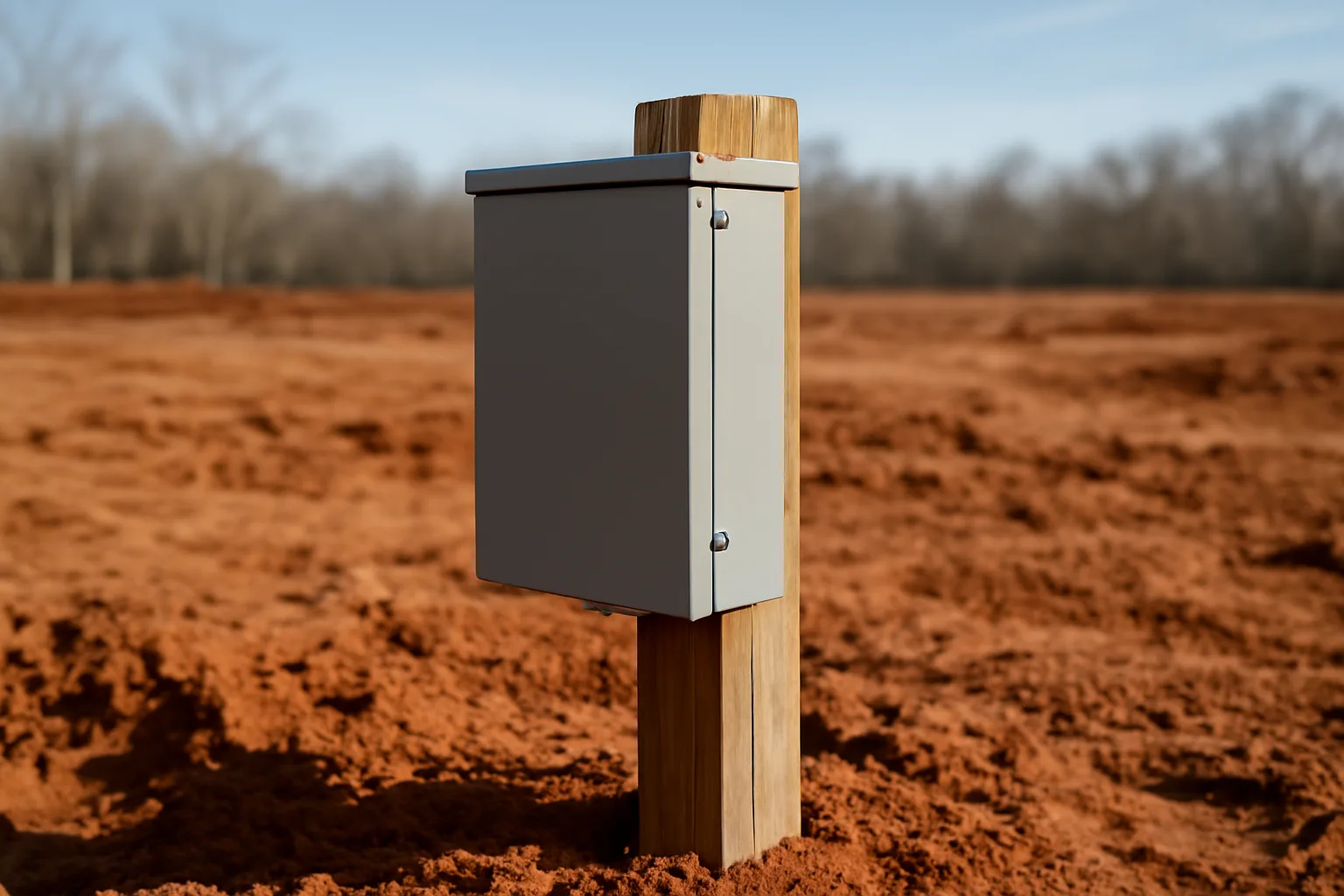
A temporary power board, sometimes called a temp pole or construction power panel, is a weatherproof electrical panel mounted on a freestanding post or skid. It supplies power to a job site before the permanent service goes in. It usually holds a main breaker, one or more 120/240V receptacles, and, on larger commercial sites, a 480V three-phase section for heavy equipment.
Tennessee treats the install as electrical work subject to permit and inspection under state building law. Tennessee Code Annotated Section 68-120-101 requires a building permit for the "construction, alteration, repair, or installation" of electrical systems, and temporary power sits squarely inside that scope [7]. This is real paperwork, not a formality. Utilities like TVA distributors and local power companies will not energize a temp service without inspection approval in most Tennessee jurisdictions.
The practical consequence is simple. You cannot drive a pole in the ground, staple on a panel, and call the co-op. The sequence is license, permit, install, inspect, energize. Skip a step and the co-op refuses to pull the meter.
Do you need a license for temp power in Tennessee?
Yes. Any person or company that installs a temporary power board for compensation in Tennessee must hold a state electrical contractor license from the Tennessee Electrical Contracting Licensing Board (TECLB), which operates under Tennessee Code Annotated Title 62, Chapter 6 [2]. The TECLB issues licenses at several tiers: Electrical Contractor (EC), Limited Licensed Electrician (LLE), and Registered Electrical Apprentice. Temp board work falls under the EC or LLE scope depending on voltage and amperage.
For a standard residential-scale temp pole, a Limited Licensed Electrician with the right endorsement can do the work. For a commercial 480V three-phase board, you need a full EC license. The TECLB exam is administered through PSI, and the license renews every two years [9].
Property owners doing their own work on property they own and occupy are sometimes exempt from the contractor license requirement under the "homeowner exemption." That exemption does not cover spec construction or any site where a hired contractor is running the build. The TECLB treats temp power at a construction site built for sale as outside the homeowner exemption. Confirm the current scope directly with the TECLB before relying on it.
There is also a local layer. Some Tennessee municipalities, including Memphis and Nashville Metro, keep their own electrical licensing requirements on top of the state license. Nashville's Metro Codes Administration, for example, requires a local electrical permit and may require registration of the contractor in their system [3]. Check with the building department of the county or city where the site sits.
How much does temp power cost in Tennessee?
The total cost of a temp power setup in Tennessee splits into three buckets: the permit fee, the equipment and installation cost, and the utility interconnection cost. Each varies by jurisdiction and project size.
Permit fees. Tennessee's building permit fee schedules are set at the local level. Under the state's building codes administration framework, jurisdictions participating in the state program submit their fee schedules to the Department of Commerce and Insurance [1]. In practice, a residential temp power permit runs roughly $50 to $150 in most mid-size Tennessee counties. Large commercial installs can trigger valuation-based fees that push past $200. The only way to get the exact current fee is to call the local building department or check their published schedule.
Equipment and installation. A basic 100A residential temp pole with receptacles and a ground rod runs roughly $400 to $900 installed by a licensed electrician in Tennessee, based on typical regional labor rates for the Southeast [4]. A 200A panel with 480V three-phase capability for a commercial site can run $1,500 to $4,000 or more depending on conduit runs, cable size, and site conditions. If you source the panel yourself rather than through the contractor, kits with the enclosure, breakers, and cabling start around $300 for basic configurations. TempPowerPath's Cable + Fuel + 480V Kit at $179 (one-time) covers the hardware spec documentation and cable sizing guide for common Tennessee commercial setups, and you can start at /start.
Utility costs. TVA distributors and local power companies typically charge a deposit and a connection fee for temporary service. Deposit amounts depend on estimated consumption and the distributor's tariff. Confirm current deposit and connection fee amounts with your local power company before budgeting.
| Cost bucket | Typical range (Tennessee) | Who sets it |
|---|---|---|
| Local building permit | $50 to $200+ | Local jurisdiction |
| Residential temp pole (100A, installed) | $400 to $900 | Contractor + materials market |
| Commercial 480V board (installed) | $1,500 to $4,000+ | Contractor + materials market |
| Utility deposit (TVA distributor) | Varies by tariff | Local power company |
| State electrical license (EC, 2-year) | Confirm with TECLB | TECLB |
These ranges reflect publicly available regional cost data and are not guarantees. Get at least two quotes from TECLB-licensed contractors before committing.
How long does temp power take in Tennessee?
The timeline has four milestones: permit issuance, installation, inspection, and utility energization. Each one adds days.
Permit issuance in most Tennessee counties takes 1 to 5 business days for a residential or small commercial temp service. Some jurisdictions with online permitting portals issue permits same-day for straightforward temp pole applications. Large or complex commercial permits can take 1 to 3 weeks if plan review is required.
Installation by a licensed electrician is usually a single-day job for a standard temp pole. A larger commercial board with conduit and multiple circuits might take 2 to 3 days.
Inspection scheduling is where delays pile up. Tennessee's state inspection program, run through the Department of Commerce and Insurance, targets inspections within a set number of business days of the request, but scheduling availability varies by region and season [1]. In rural counties with few inspectors, waits of 5 to 7 business days are common during peak construction season (spring and summer). Urban areas with more inspectors can often schedule within 1 to 3 business days.
After a passing inspection, the utility schedules the meter pull and energization. TVA distributors and co-ops typically finish this within 3 to 10 business days, though urgent requests sometimes move faster.
A realistic total from permit application to live power on a residential temp pole is 1 to 3 weeks in a well-staffed urban jurisdiction and 2 to 5 weeks in a rural county during busy season. Plan for the longer end. Nobody has hard statewide data on average temp power timelines in Tennessee specifically; these ranges come from published state inspection program targets and regional contractor experience reported in industry forums.
What are Tennessee's electrical code requirements for a temp board?
Tennessee adopted the 2020 National Electrical Code (NEC) as its base electrical standard, with state amendments [5]. For temp power, NEC Article 590 governs. Article 590 sets rules on acceptable wiring methods, weatherproofing, GFCI protection on 125V 15A and 20A receptacles, support requirements for the panel and conductors, and the required disconnecting means.
The Tennessee Department of Commerce and Insurance, Codes Enforcement Section, administers adoption and amendment of the NEC for the state [1]. Local jurisdictions that have adopted their own codes may run a different edition in some cases, though most Tennessee counties follow the state-adopted edition.
Key NEC 590 requirements that come up on Tennessee inspections:
- Temporary wiring is allowed for "the period of construction, remodeling, maintenance, repair, or demolition" and must be removed "immediately upon completion" of the work [5].
- All 125-volt, single-phase, 15- and 20-ampere receptacles on the temp board must have GFCI protection.
- The panel must be protected from physical damage, weather, and moisture. An outdoor-rated enclosure is required.
- Equipment grounding conductors are required on all circuits.
- Flexible cords and cables must be protected from damage; running them through doorways, windows, or holes is not allowed.
Some Tennessee counties add local amendments on setback distances for the temp pole from the property line or roadway. Check the local building department's specific requirements before setting the pole.
How do Tennessee's major utilities handle temporary service requests?
The Tennessee Valley Authority (TVA) supplies wholesale power across most of Tennessee, but retail delivery goes through local power companies and electric cooperatives, each with its own service application process [6]. There is no single statewide application form for a temp service.
The general process across TVA distributors looks like this. You or your contractor contacts the local power company's new service or engineering department, submits a service application for temporary construction power, specifies the panel size and load, and pays a deposit. The power company sets a transformer and meter base if needed, or uses an existing one nearby. After the local building department inspection clears, the power company pulls the meter and energizes.
In Nashville, NES (Nashville Electric Service) handles this. In Memphis, MLGW. In rural West Tennessee, Chickasaw Electric Cooperative or similar co-ops. In East Tennessee, many sites are served by local cooperatives, with Appalachian Power (AEP) covering the easternmost corner [6]. Each distributor has its own deposit policy, tariff rates, and scheduling process. Contact the specific distributor for current requirements before you start permitting.
Who inspects temp power installations in Tennessee?
Inspection authority in Tennessee depends on whether the jurisdiction runs a local inspection program or uses the state program.
Tennessee's Department of Commerce and Insurance, Codes Enforcement Section, runs the state building inspection program for jurisdictions that have not established their own [1]. About 40% of Tennessee's counties use the state program. The rest have local programs run by city or county governments with their own electrical inspectors.
In jurisdictions with a local program, you schedule the inspection with the local building department. In jurisdictions under the state program, you request an inspection through the state's online portal or by calling the regional office. The inspector who shows up has authority to approve or reject the install based on the adopted NEC and any local amendments.
For temp power specifically, the inspector checks the panel enclosure rating, GFCI protection, grounding, conductor sizing, and the disconnect. A failed inspection means corrections and a re-inspection, which adds to the timeline. Getting your licensed electrician to walk through the NEC 590 checklist before calling for inspection is the fastest way to avoid a failed trip.
What happens if you install a temp board without a permit in Tennessee?
Operating a temp board without a permit in Tennessee exposes you to several layers of trouble. Under Tennessee Code Annotated Section 68-120-111, local building officials have authority to issue stop-work orders for unpermitted construction [8]. A stop-work order halts the entire job site, well beyond the electrical work.
Beyond the stop-work order, you can face civil penalties and be required to remove and reinstall the electrical work with proper inspections, which costs more than the permit would have. The utility can also pull the meter if it discovers a temp service that never got inspection approval.
If a fire or injury happens at a site with unpermitted electrical work, insurance claims get complicated fast. Commercial general liability and builder's risk policies routinely exclude losses caused by work that did not meet code requirements or was not properly permitted. That exclusion can be catastrophic on a large project.
The permit is the document that keeps your insurance valid and your project legal. That is the whole point of it.
How does Tennessee temp power compare to neighboring states?
Tennessee sits in the middle of the pack for electrical licensing complexity compared to its neighbors.
Georgia requires a state electrical contractor license and local permits, similar to Tennessee, but Georgia's licensing exam and continuing education requirements run through a different board structure. See the temp power board in Georgia article for specifics.
Alabama also requires a state electrical license for temp power installation. Alabama's licensing runs through the Alabama Electrical Contractors Board, and some counties add local requirements on top. The temp power board in Alabama guide covers that path.
Arkansas requires a state license and local permits, and its inspection timeline in rural counties is often longer than Tennessee's because of fewer state inspectors. Details are in the temp power board in Arkansas article.
Florida runs a more layered system, with both state and local licensing requirements that can be more demanding than Tennessee's, particularly in larger counties. The temp power board in Florida piece breaks down that path.
| State | State electrical license required? | Adopts NEC? | Notes |
|---|---|---|---|
| Tennessee | Yes (TECLB) | 2020 NEC (with amendments) | Local permit required |
| Georgia | Yes (state board) | 2020 NEC | Local amendments common |
| Alabama | Yes (AECB) | 2020 NEC | Some counties add local license |
| Arkansas | Yes | 2020 NEC | Rural inspection delays noted |
| Florida | Yes (state + local layers) | 2020 NEC | More complex dual-license system |
Sources for neighboring state details are listed in the citations below and in the linked articles.
How do you actually apply for a temp power permit in Tennessee?
The process is local, not statewide, so the exact steps depend on your county or city. The general path looks like this.
First, confirm whether your jurisdiction uses the state inspection program or a local one. Call the county clerk's office or the building department and ask. If local, get the building department's permit application for electrical work. If state, go through the Tennessee Department of Commerce and Insurance's Codes Enforcement portal.
Second, fill out the permit application. For a temp power permit you typically need the site address, the contractor's TECLB license number, the panel size (amps), the voltage (120/240V or 480V), a simple site plan showing where the temp pole will sit relative to the building footprint, and the estimated duration of use.
Third, pay the permit fee. Most jurisdictions accept payment online or in person. Keep your receipt.
Fourth, have the licensed electrician do the installation per NEC 590 and any local amendments.
Fifth, request the inspection through the appropriate office. The inspector schedules a visit, usually within 1 to 5 business days.
Sixth, after a passing inspection, contact the utility with the inspection approval and complete their service application. They schedule meter installation and energization.
The whole stack is paper-heavy but not technically complicated. The licensed electrician you hire should know the local permit office and utility process cold. If they do not, find a contractor who does.
Resources for temp power in Tennessee: where to go for official information
These are the official sources you should go to, not third-party summaries.
Tennessee Electrical Contracting Licensing Board (TECLB): For license verification, exam requirements, and disciplinary records. The TECLB operates under the Tennessee Department of Commerce and Insurance [2].
Tennessee Department of Commerce and Insurance, Codes Enforcement Section: For the state inspection program, adopted building codes, and permit processes in jurisdictions using the state program [1].
Your local building department: For local permit fees, scheduling, and any local amendments to the NEC. This is the most important call you make before starting.
Your local utility or TVA distributor: For the service application, deposit requirements, and energization scheduling [6].
NFPA 70 (National Electrical Code), Article 590: For the specific technical requirements your installation must meet [5].
For a starting point on equipment specs and cable sizing for a 480V temp board setup, the TempPowerPath /start page has a one-time kit ($179) that covers the documentation side without replacing the licensed contractor requirement.
None of these resources replaces the advice of a TECLB-licensed electrician who knows your specific site and the local AHJ (Authority Having Jurisdiction). The paper path described here is the standard one. Local quirks matter.
Frequently asked questions
Do you need a license for temp power in Tennessee?
Yes. Installing a temporary power board for compensation in Tennessee requires a state electrical contractor license from the Tennessee Electrical Contracting Licensing Board (TECLB), operating under Title 62, Chapter 6 of Tennessee Code Annotated. A Limited Licensed Electrician can handle residential-scale installs; a full Electrical Contractor license is required for 480V three-phase commercial boards. Some municipalities add a local registration requirement on top of the state license.
How much does temp power cost in Tennessee?
Budget three separate costs: a local permit fee (typically $50 to $200 depending on jurisdiction), installation by a licensed electrician ($400 to $900 for a residential 100A temp pole, $1,500 to $4,000+ for commercial 480V setups), and a utility deposit and connection fee set by your local power company or TVA distributor. None of these amounts are fixed statewide; confirm each with the relevant local authority before committing.
How long does temp power take in Tennessee?
A realistic total from permit application to live power is 1 to 3 weeks in an urban Tennessee jurisdiction and 2 to 5 weeks in a rural county during peak construction season. Permit issuance takes 1 to 5 business days, installation is usually 1 to 3 days, inspection scheduling adds 1 to 7 business days, and utility energization takes 3 to 10 business days after a passing inspection. No hard statewide average exists; rural counties during spring and summer run slowest.
Which NEC edition does Tennessee use for temp power?
Tennessee adopted the 2020 National Electrical Code, with state amendments, as its base electrical standard. NEC Article 590 specifically governs temporary wiring installations including temp power boards. The Tennessee Department of Commerce and Insurance administers code adoption. Some local jurisdictions may run a different edition, so confirm with the local building department before design work.
Can a homeowner install a temp power board in Tennessee without a license?
A homeowner exemption exists under Tennessee law for work on property you own and personally occupy, but it does not apply to construction sites being built for sale or where a general contractor is overseeing the build. Most temp power board situations involve a construction site, which falls outside the homeowner exemption. Confirm the specific scope of any exemption directly with the TECLB before relying on it.
What does NEC Article 590 require for a temp power board?
NEC Article 590 requires that temp wiring be removed immediately upon completion of construction, that all 125V 15A and 20A receptacles have GFCI protection, that the panel sit in a weatherproof outdoor-rated enclosure, that equipment grounding conductors run with every circuit, and that flexible cords not pass through walls, windows, or holes. Tennessee adopted the 2020 NEC, so these are the applicable requirements unless your local jurisdiction has an amendment.
Does TVA directly handle temp power connections in Tennessee?
No. TVA supplies wholesale power but retail delivery and service connections go through local power companies and electric cooperatives. In Nashville, NES handles service. In Memphis, MLGW. In rural areas, the local cooperative does. Each distributor has its own service application, deposit policy, and energization schedule. Contact the specific power company serving your site, not TVA directly, for a temporary construction service application.
What is the Tennessee Electrical Contracting Licensing Board?
The TECLB is the state board that licenses electrical contractors in Tennessee under Title 62, Chapter 6 of Tennessee Code Annotated. It issues Electrical Contractor, Limited Licensed Electrician, and Registered Electrical Apprentice credentials. Exams run through PSI. Licenses renew every two years. The board also handles complaints and disciplinary actions against licensees. Its operations fall under the Tennessee Department of Commerce and Insurance.
Can a temp power board be used for long-term power in Tennessee?
NEC Article 590, as adopted by Tennessee, limits temporary wiring to the duration of construction, remodeling, maintenance, repair, or demolition, and requires removal immediately upon completion. Using a temp board as a permanent power source is a code violation. If you need extended power before a permanent service is ready, the correct path is a permanent service installation, not an indefinitely extended temp permit.
What voltage is a standard construction temp board in Tennessee?
Residential and light commercial job sites typically use a 120/240V single-phase temp board at 100A or 200A. Large commercial and industrial sites use 480V three-phase boards, which require a full Electrical Contractor license for installation in Tennessee. The voltage and amperage needed determine the panel size, cable sizing, and the utility transformer capacity required. Confirm the specific load requirements with the electrician designing the temp service.
Do Nashville or Memphis have additional temp power rules?
Yes. Nashville Metro Codes Administration maintains its own electrical permit process and may require contractor registration in their system in addition to the state TECLB license. Memphis and Shelby County run their own building department processes. Both cities generally follow the state-adopted NEC but may have local amendments. Always check with the specific city or county building department for current requirements before applying for a permit.
What causes a temp power inspection to fail in Tennessee?
Common failure points include missing GFCI protection on 15A and 20A receptacles, non-weatherproof panel enclosures, missing or undersized grounding electrodes, improper conductor sizing, flexible cords run through walls or windows, and panels without a proper main disconnect. Going through the NEC Article 590 checklist with your electrician before calling for inspection prevents most re-inspection delays.
Is a temp power permit required for a generator connection on a job site in Tennessee?
A portable generator powering tools through extension cords typically does not require a permit in Tennessee, but connecting a generator to a panel with a transfer switch or interlock does require a permit and inspection. The line is whether the connection ties into fixed wiring. When in doubt, call your local building department; the answer varies by jurisdiction and by how the generator is connected.
Sources
- Nashville.gov, Metro Codes and Building Safety Department: Nashville Metro Codes Administration requires a local electrical permit and contractor registration for electrical work, including temporary power installations, in addition to the state license.
- U.S. Bureau of Labor Statistics, Occupational Employment and Wage Statistics, Electricians (47-2111): Regional electrician labor rates in the Southeast inform the installed cost range of $400 to $900 for a residential 100A temp pole in Tennessee.
- NFPA 70, National Electrical Code 2020, Article 590 Temporary Installations: NEC Article 590 requires temporary wiring to be removed immediately upon completion of construction, GFCI protection on 125V 15A and 20A receptacles, weatherproof enclosures, and equipment grounding on all circuits.
- Tennessee Valley Authority, Electricity Distribution: TVA supplies wholesale power in Tennessee but retail temporary construction service connections are handled by local power companies and electric cooperatives, each with their own service application and deposit policies.
- Tennessee Code Annotated Section 68-120-101 via Justia, State Building Construction (Contractors' Licensing and Building Codes): TCA Section 68-120-101 establishes the requirement for building permits covering construction, alteration, repair, or installation of electrical systems in Tennessee.
- Tennessee Code Annotated Section 68-120-111 via Justia, Stop-Work Orders: TCA Section 68-120-111 authorizes local building officials to issue stop-work orders for unpermitted construction including unpermitted electrical installations.
- PSI Exams Online, Candidate Catalog: PSI administers the Tennessee electrical contractor licensing examinations on behalf of the state board.
- Georgia Secretary of State, Construction Industry Licensing Board: Georgia requires a state electrical contractor license for temp power installation, administered through the Construction Industry Licensing Board, comparable in structure to Tennessee's system.
- Alabama Electrical Contractors Board: Alabama requires a state electrical contractor license for temp power installation, administered through the Alabama Electrical Contractors Board.