Last updated 2026-08-18
TL;DR
In Alaska, installing a temporary power board demands a licensed electrical administrator or a journeyman electrician working under supervision [1]. The state charges a minimum electrical permit fee of $60 for temporary services based on contract value [3]. Utility hookup can take 1 to 3 weeks, and renting a spider box in Alaska generally costs $200 to $800 per month [6]. Always verify current fees with the Division of Labor Standards and Safety before starting.
What does a temp power board do on an Alaskan job site?
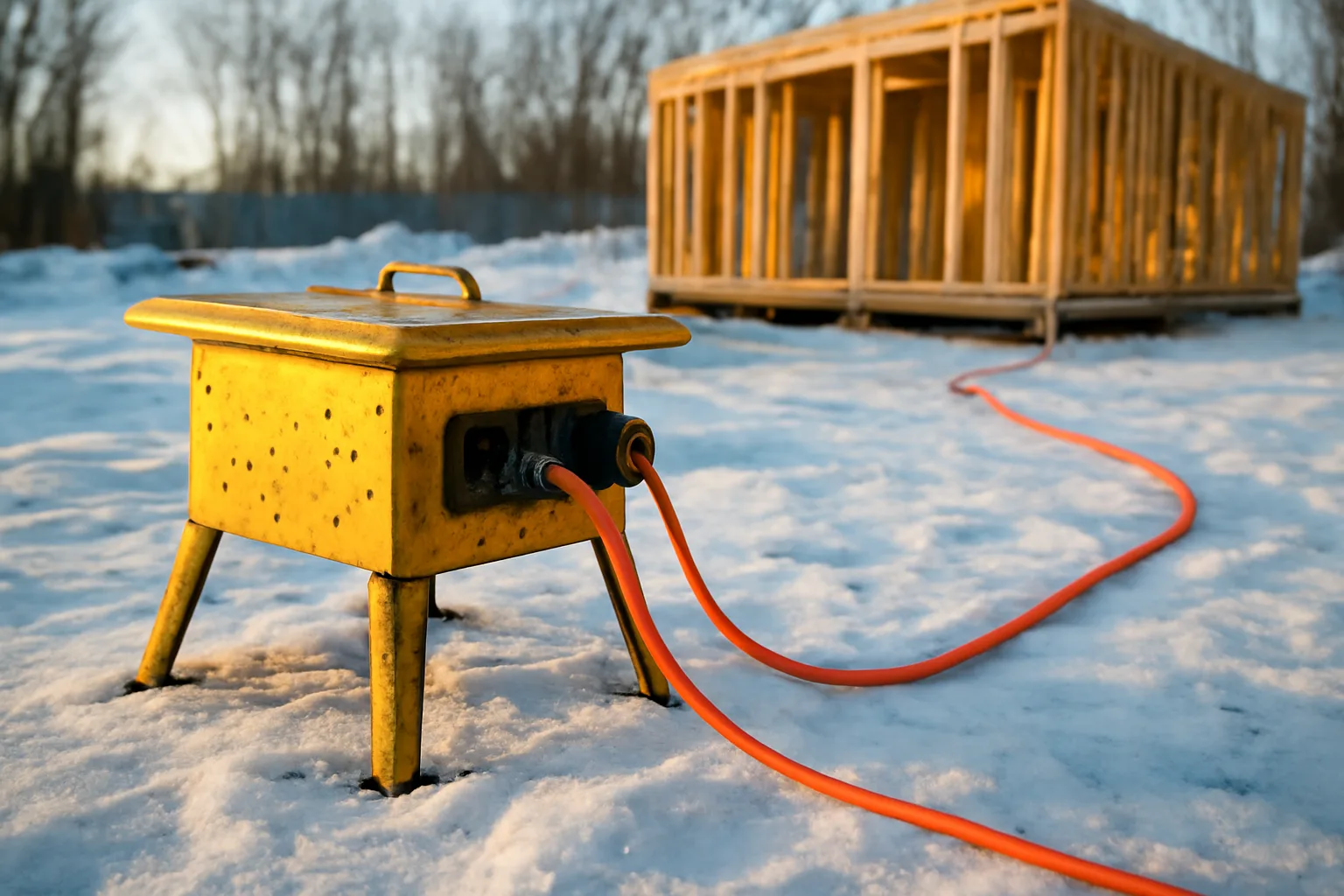
A temp power board is a portable distribution panel. It takes 240-volt or 480-volt service from a generator or a temporary utility drop and breaks it down into 120-volt and 240-volt outlets. On a remote residential build outside Fairbanks, you might plug a spider box into a diesel generator. On a commercial gut rehab in Anchorage, the board ties into a temporary meter socket the utility installed. Either way, you need GFCI-protected receptacles and a weatherproof enclosure.
In Alaska, the same UL-listed board you’d use in the Lower 48 works. The difference is logistics. A site in Bethel might need the board flown in with a freight fuel surcharge. A winter foundation in Juneau means the board sits in slush and zero-degree air for weeks. The National Electrical Code (NEC) applies fully. Alaska adopted the 2020 NEC with state amendments in 12 AAC 32.700 [5], so all temp power boards must meet NEC 590 requirements for temporary installations.
Do you need a license for temp power in Alaska?
Yes. Alaska law is clear. AS 08.40.290 states: "A person may not engage in the business of electrical administration or perform electrical work without an electrical administrator license" [1]. Connecting a temp board is electrical work. You're tying in branch circuits, setting overcurrent protection, and often bonding to a grounding electrode. That's not DIY territory.
The electrical administrator holds the license. They can employ journeyman electricians who work under supervision. A site can use an owner-builder exemption only if it’s a single-family home where the owner will live, and they pull the permit and do the work personally. Even then, many local utilities require proof of a licensed electrician before energizing a temporary service.
If you’re the general contractor without a license, you hire a state-licensed electrical shop. They pull the electrical permit under their administrator’s license. No workaround exists. The Division of Labor Standards and Safety can issue stop-work orders and fines up to $10,000 for unlicensed electrical work [2].
How much does temp power cost in Alaska?
The total cost has three layers: the state electrical permit, the utility connection, and the equipment itself.
State permit: Alaska’s electrical permit fee is based on the contract value of the electrical work. For a temporary service under $1,000 in labor and materials, the minimum fee is $60. The schedule charges $60 for the first $1,000 and $6 per additional $1,000 [3]. A typical temp power hookup with a panel and a couple of circuits falls into that $60 minimum.
Utility hookup: The local cooperative or municipal utility charges a temporary service connection fee. Chugach Electric, for example, lists a new service installation charge of $300 for up to 200-amp single-phase temporary meters [4]. The fee covers the meter base, inspection, and energization. Expect similar numbers from Golden Valley Electric Association in Fairbanks or Matanuska Electric Association. Add a refundable deposit of $100 to $500 if you don’t have an established account.
Equipment: A basic 50-amp spider box with six GFCI duplex outlets rents for about $30 a week in the Lower 48. In Alaska, freight and handling push the monthly rental to $200 on the low end and $800 for a heavy-duty 100-amp unit in a remote spot [6]. A one-time purchase runs $1,200 to $3,500 for a commercial-grade temp power board.
How long does temp power take in Alaska?
Three phases, each with its own timeline.
First, the electrical permit. When a licensed administrator submits a complete application online through the state’s permit portal, approval is often instant. The Division of Labor Standards and Safety says most permits are issued within 24 hours for standard work [5]. Complexity or missing details can push it to three business days.
Second, the utility. After you have the permit, you request a temporary service drop. Processing and scheduling can take two to three weeks in peak summer construction months. In winter, when excavation is harder, waits may stretch to four weeks. Chugach Electric advises submitting the application at least two weeks before you need power [4]. Remote communities served by smaller co-ops may be faster, but they often have only one crew.
Third, the physical install. Once the meter is set and the disconnect is hot, a licensed electrician can mount the board, run a feeder, and land the branch circuits in three to six hours. Weather can add time. Ice fog, frozen ground, and darkness are real delays. Plan for a full day from equipment delivery to tested 120-volt power if the setup is outdoors in early November.
What is the permit pathway for temporary services in Alaska?
The state process is short but unforgiving if you skip a step. The responsible electrical administrator files a permit application with the Division of Labor Standards and Safety. The application lists the project scope, contractor license number, and estimated value. For a temp pole or board, you mark "temporary service" on the permit.
Once the permit is issued, the state electrical inspector may conduct a rough-in inspection before the utility connects. Temporary services often get the "OK to energize" tag after a visual check. No power up until that tag is signed. The final inspection happens when all temporary wiring is complete and the board is fully dressed.
The permit fee is due at application. The state no longer sends paper permits. You print it yourself. Keep a copy on site. An inspector can ask for it at any time. Failing to have a permitted temporary service is treated like any other unpermitted work, with the same fines and liability.
How do you get a temporary service drop from an Alaska utility?
Alaska has over 50 electric utilities, from big railbelt cooperatives to tiny village systems. Their requirements vary. Most follow a similar script: you need a state electrical permit, a site plan showing the temporary service location, and a load calculation for the equipment you’ll power.
Chugach Electric requires a temporary service application and a $300 connection fee for a 200-amp single-phase service [4]. The meter socket must be UL-listed and mounted on a temporary pole or a stand. The utility provides the meter. They will not energize until the state inspector releases the service.
In villages served by Alaska Village Electric Cooperative, the process may involve a local lineman who knows every resident. Paperwork can be lighter, but lead times can be longer simply because the crew flies in. Always call the utility before you buy the meter base. Some co-ops maintain a list of pre-approved meter sockets. A wrong meter base can add two weeks of back-and-forth.
What do cold weather and remote sites do to a temp power board in Alaska?
A spider box that worked in Phoenix will not magically survive January in Fairbanks. The enclosure must be NEMA 3R rated for outdoor use. GFCI receptacles can trip more often in damp cold. Moisture condenses inside the box during temperature swings. You need a board with internal heaters or at least a weatherproof cover that sheds snow.
Remote sites require special planning. Freight to Nome or Kotzebue can cost more than the board itself. A common Alaska trick is to build a small insulated shed around the board and run cords through a sealed opening. That keeps the device out of the wind and snow, which reduces nuisance tripping.
Fuel for generators freezes at minus 40. A diesel-fired generator needs a winter-blend fuel and possibly a battery warmer. The board itself draws negligible power, but if you're relying on it for portable heaters, the total load calculation matters. The utility or generator must handle the startup surge of whatever you plug in.
What temp power equipment should you rent, buy, and spec?
The most common temp power board on Alaskan sites is a 50-amp spider box with 120-volt GFCI duplex receptacles. Brands like Ericson, Leviton, and Eaton dominate. If you need 480-volt input to 120/240-volt output, you step up to a power distribution rack. Those rent for $400 to $900 per month in Alaska [6].
Buying might make sense if you work multiple remote jobs. A rugged 50A inline GFCI spider box costs about $1,800 new from an Alaska industrial supplier. You’ll also need a feeder cable. A 50-foot 6/4 SOOW cord with twist-lock connectors can run $350. Don't skimp on the cable gauge; voltage drop over long runs in cold temperatures is real.
Consider kits. A single-purchase cable and 480V kit from sources like TempPowerPath ships complete and can shorten procurement time, but verify the equipment has a valid NRTL listing (UL, ETL, or CSA) acceptable to Alaska inspectors.
What safety and inspection rules are specific to Alaska?
Alaska runs a state electrical inspection program under the Division of Labor Standards and Safety. They enforce the NEC as adopted. For temporary power, NEC Article 590 requires GFCI protection for all 125-volt 15- and 20-amp receptacles at construction sites. No exceptions. An inspector will check that the board has functioning GFCI devices and that they test correctly.
The state also requires a written safety plan if the site is covered by OSHA standards. While OSHA is federal, Alaska’s Department of Labor has its own consultation program that works with small employers. They will walk a site for free and point out hazards before the formal inspection.
A dead front or missing knockouts on the board is an instant red tag. Keep a spare GFCI receptacle in your toolbag. They fail often in the cold. An inspector who sees a taped-up, bypassed GFCI will likely shut down the whole temporary setup.
What are the steps from permit to power-on?
Here is the paper path for a typical jobsite near Anchorage. Nothing in this list guarantees a timeline, but it's the order that keeps you out of trouble.
1. Hire a licensed electrical administrator or contractor. They log into the state permit portal and file an electrical permit for temporary service. Pay the $60 minimum fee [3]. 2. Apply to your utility (Chugach Electric, MEA, etc.) for a temporary service connection. Submit the site plan and permit. Pay the connection fee ($300 typical) [4]. 3. Order or rent the temp power board, feeder cable, and meter base. Confirm meter base model with the utility. 4. Set the temporary pole or service stand. The licensed electrician mounts the meter base, disconnect, and the board. Do not energize. 5. Request the state electrical inspection. The inspector signs off the rough-in and releases the service. 6. The utility installs the meter and energizes the service. The electrician verifies voltage and tests all GFCI devices. 7. You now have legal, inspected temporary power. Keep the permit and the inspection tag at the board.
What common mistakes delay temp power in Alaska?
A surprising number of job sites lose a week because the electrician’s license is expired or classified wrong. Alaska issues electrical administrator licenses by category: inside wireman, residential wireman, maintenance, etc. A residential wireman cannot pull a permit for a commercial project. Verify the license classification online at labor.alaska.gov before the paperwork starts.
Another mistake is assuming the utility will show up fast. In the Mat-Su Valley, summer construction demand can fill the schedule six weeks out. If you call the utility after the foundation is poured, you’re late. Put the service request in as soon as you have a lot address.
Underpaying the permit fee is the quiet one. The minimum is $60, but if the contractor writes a contract value of $1,100 for the temp work, the fee jumps to $66. An underpaid permit gets flagged and returned. That’s a pure administrative delay.
Frequently asked questions
Can I do a temp power board install myself on my own hunting cabin?
Alaska’s owner-builder exemption lets you pull an electrical permit for your primary residence. The cabin must be your home, not a rental or future Airbnb. You must do the work yourself. Even so, the utility may still require a licensed electrician before they will connect a temporary service. Check with your co-op first.
Is a separate permit needed for a generator-fed temp board instead of utility power?
The state still requires an electrical permit any time you install wiring and overcurrent devices. A generator-fed board is a temporary installation under NEC Article 590. The licensed administrator pulls one permit for the entire temp setup whether it’s utility-connected or generator-fed. No separate generator permit is required at the state level, though some municipalities may have noise or fuel storage rules.
How much does a temp power board rental cost per day in Alaska?
Most rental houses quote weekly or monthly rates. Day rates are rare. Weekly rates for a 50-amp spider box range from $80 to $150 in Anchorage. In Fairbanks, winter rates may include a cold-weather surcharge. Month-long rentals give you a better rate, typically $200 to $500. Remote locations can double those numbers because of freight.
Does the state electrical inspector inspect temporary services differently in rural Alaska?
The same NEC and state code apply everywhere. In villages off the road system, the inspector may fly in once a month. You schedule the inspection around the visit. If you miss it, you wait. Some inspectors will accept photos and a video walkthrough for simple temporary services when travel is impossible, but that’s at the inspector’s discretion, not a right.
What size temp power board do I need for a single 1,500-square-foot house build?
A 50-amp spider box with at least four 20-amp GFCI duplex receptacles covers most house construction. You’ll run a miter saw, a compressor, and a couple of chargers simultaneously. If you add a job-site trailer with electric heat, you might need a 100-amp board or a second 50-amp unit. Do a load calculation and have the electrician size the feeder and overcurrent protection.
Are there any state tax credits for using temporary power equipment?
No. Alaska has no state sales tax, so you avoid that markup, but there are no specific tax credits or rebates for temp power boards. Some federal energy provisions for construction equipment might apply if the board is part of a broader clean energy project, but those are rare. Talk to your CPA.
Can I move a temp power board from one job to another without a new permit?
No. An electrical permit is site-specific. Moving the board to a new address, even across the street, requires a new permit. The inspection tag is tied to the original project. If you reuse the same equipment on a different site, the licensed administrator files a new permit. Reusing equipment is fine; reusing the old permit isn’t.
What kind of temp power board holds up best in coastal Alaska rain?
Choose a NEMA 3R or 4 rated enclosure. 3R is the minimum for outdoor use. In places like Ketchikan or Cordova with constant rain, a NEMA 4 board offers better water protection. Fiberglass enclosures last longer than painted steel because salt spray won’t corrode them as fast. All inlet and outlet gaskets should be intact and tight.
Do I need a business license in Alaska to rent out temp power boards?
If you own the equipment and rent it as a service, you may need a state business license. The equipment rental itself does not require an electrical license because you are not installing it. The person installing and connecting the board must have the electrical license. Consult the Alaska Department of Commerce for business licensing requirements.
How do I find an electrical administrator in Alaska?
The Division of Labor Standards and Safety maintains a searchable license database online. You can look up active electrical administrators by name or license number. Local contractors’ boards, online industry directories, and the Alaska chapter of the Independent Electrical Contractors association can also help. Verify the license status and classification before you sign a contract.
Can I use a temp power board to feed a small off-grid cabin permanently?
Technically, a temporary board is for construction and short-duration events under NEC Article 590. A permanent off-grid system falls under different articles and requires fixed wiring methods, disconnects, and an electrical inspector’s permanent service approval. Using a spider box long-term as a main panel may not pass inspection and can create fire and compliance risks. Install a proper load center.
Sources
- Alaska Legislature, AS 08.40.290 Electrical administrator license required: Performing electrical work without an electrical administrator license is prohibited in Alaska.
- Alaska Administrative Code, 12 AAC 32.010 Electrical administrator categories and requirements: Fines up to $10,000 for unlicensed electrical work and license classification rules.
- Alaska Department of Labor and Workforce Development, Electrical Permit Fee Schedule: State electrical permit fees start at $60 for the first $1,000 of contract value and $6 per additional $1,000.
- Chugach Electric Association, Temporary Service page: Chugach Electric temporary service connection fee is $300 for up to 200-amp single-phase and at least 2-week application lead time.
- Alaska Department of Labor and Workforce Development, Electrical Inspections and Permitting: State electrical permits are often issued within 24 hours for complete applications; Alaska adopts NEC 2020 via 12 AAC 32.700.
- Sunbelt Rentals, Spider Box Temporary Power Distribution: Equipment rental rates noted; Alaska pricing typically 20-30% higher than listed national averages due to freight and handling.