Last updated 2026-08-18
TL;DR
Yes, you need a licensed C-10 electrical contractor in California for any temp power board installation that involves new wiring. Setup costs typically range from $600 to $2,000, covering equipment rental, electrician labor, and a local permit. Once an electrician is scheduled, the physical install takes one to two days, but permit and utility-connection delays can push the overall timeline to several weeks.
What Is a Temp Power Board in California?
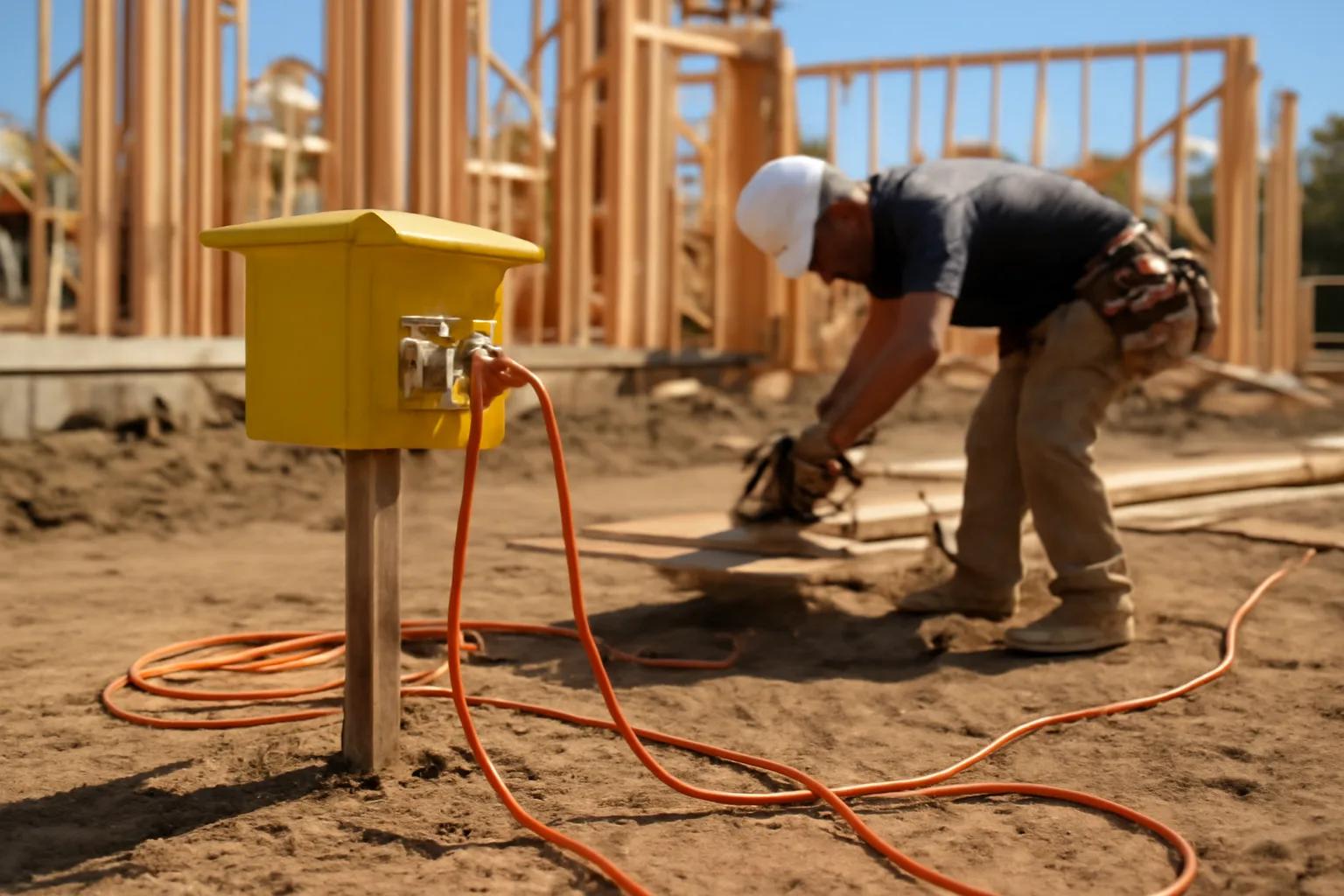
A temp power board (often called a temporary power distribution board or T-panel) is a portable metal box with breakers and receptacles that brings 120V, 208V, or 480V power to a job site, outdoor event, or emergency setup. In California, these boards are common on construction sites where a permanent panel isn’t live yet. They let crews run saws, lights, and chargers from a single feed, usually a generator or a temporary utility pole.
The board itself is a pre-wired assembly. You connect it to a power source, then plug in tools. But the wiring between the source and the board, and the board’s internal overcurrent protection, must meet the California Electrical Code (Title 24, Part 3) [1]. That’s where licensing and local rules kick in. A board that looks simple can require a permit and a C-10 contractor if you’re connecting it to anything that didn’t already have a receptacle waiting for you.
Do You Need a License for Temp Power in California?
Yes. California law is clear: any person who contracts for electrical work valued at $500 or more (combined materials and labor) must hold a C-10 Electrical Contractor license from the Contractors State License Board (CSLB) [2]. Business and Professions Code § 7028 makes it a misdemeanor to act as a contractor without a license [3].
The $500 threshold catches most temp power board setups. Even if you rent the board, the electrician who mounts it, wires it to a temporary pole or generator inlet, and lands the conductors is performing contracting work. If you do it yourself on your own property, you can act as an owner-builder, pull the permit, and hire a licensed electrician for the final connection. But an unlicensed handyman can’t pull the permit or legally do the wiring.
Plug-and-play setups are the exception. If you have a factory-assembled board that connects via a cord and plug into an existing, live receptacle, no new wiring, no permit, no license needed. But that only works when there’s already a temp outlet waiting, which isn’t the usual scenario on a raw lot. For almost every real temp power install, you call a C-10.
The CSLB clarifies the C-10 classification covers all “electrical work” including temporary power distribution [2]. Inspectors in California will red-tag a job if the board isn’t installed by a licensed contractor and the permit isn’t posted.
How Much Does Temp Power Cost in California?
A basic one-week temp power board setup in California runs $600 to $2,000, depending on the equipment, electrician rates, permit fees, and whether you need a new temporary utility pole. For a generator-fed board, the lower end holds.
Here’s a realistic breakdown:
| Cost Component | Low End | Typical | High End |
|---|---|---|---|
| Equipment rental (1 week) | $150 | $250 | $400 |
| Electrician labor (4 hours) | $200 | $300 | $600 |
| Electrical permit | $25 | $50 | $200 |
| PG&E temporary service pole (if needed) | $350 | $500 | $700 |
| Total (with pole) | $725 | $1,100 | $1,900 |
Equipment rental costs reflect a small 50-amp temporary power distribution box from typical California rental yards. The weekly rate for a basic unit lands between $150 and $400, with $250 as a common midpoint [4].
Electrician labor varies by location. The Bureau of Labor Statistics reports a mean hourly wage for electricians in California at $37.67 as of May 2023, but contractor billing rates are higher. Survey data from Angi shows California electricians charge $45 to $150 per hour, with a typical rate around $75 [5]. A straightforward four-hour install (mount board, pull feeds, connect, test) accounts for the labor line. If the job needs trenching for underground feeders, labor will climb.
Electrical permit fees differ by city. In Los Angeles, the minimum electrical permit fee is $50 for work valued up to $500 [6]. Smaller jurisdictions may charge less, while cities like San Francisco can run $150, $200 for a stand-alone temporary pole permit.
PG&E’s temporary service connection adds a big variable. The utility’s fees for a temporary meter and pole range from about $350 for a simple overhead service to $700+ for an underground feed, plus the customer’s own pole and panel costs [7]. Plan several weeks for PG&E to schedule the connection.
If you skip the utility pole and feed the board from a generator, you eliminate the PG&E line, bringing the typical cost down to around $600, $650, assuming you already own or rent the generator.
How Long Does a Temp Power Setup Take in California?
The physical installation of a temp power board usually takes one to two days once an electrician is on site. But the calendar time from “I need power” to “we have power” is longer, shaped by permit wait times and utility schedules.
In cities with same-day over-the-counter electrical permits (like Los Angeles for small jobs), the permit part can be resolved in a few hours [6]. You visit the building department, pay the fee, and leave with a permit. In other cities that require plan review, even for a temporary pole, expect one to two weeks for the permit to clear.
PG&E’s temporary service connection is the real bottleneck. After you have your permit and your electrician installs the pole and riser, PG&E needs to schedule a crew to connect the transformer. Wait times of two to six weeks are common, depending on the district and season [7]. A generator-fed setup avoids this timeline entirely. You can be running power the day the board arrives if you have a licensed electrician ready.
So, realistic timelines:
Generator-fed temp power board: 1 to 3 days total (electrician schedule plus any minor permit delay).
Utility-fed temp power with PG&E: 3 to 8 weeks (permit processing plus PG&E schedule).
Always factor in a buffer. Many California job sites lose the first week because the temp power was treated as an afterthought. Order the board, call your C-10 electrician, and submit the permit application all in the same week during project planning.
What Permits Are Required for Temporary Power in California?
Most California cities and counties require an electrical permit for any temporary power installation that connects to the grid or alters building wiring. The specific permit is often called a “temporary electrical permit” or a “T-pole permit” when it includes a temporary utility pole. The California Electrical Code, adopted as Title 24, Part 3, gives local building departments the authority to enforce the permitting requirement [1].
Permit fees are based on the valuation of the work. In Los Angeles, the minimum fee is $50, covering work up to a $500 valuation [6]. If your work costs more (say, labor plus equipment totals $800), the fee scales up. A Los Angeles electrical permit for $1,000, $2,000 of work runs about $75, $100. Other jurisdictions, like San Francisco, have higher minimums.
Some rural counties or agricultural areas may exempt cord-and-plug temporary boards from permits when no new wiring is involved. But the moment you tap into a panel or add a new circuit, the permit trigger trips. A licensed C-10 contractor typically pulls the permit on your behalf, posts the job card, and calls for inspection after the install. The inspector checks that the board is listed, GFCI protection is present, the ground rod is driven, and all connections are tight. If you skip the permit and get caught, you’ll face stop-work orders and possibly fines.
For a generator-only setup with no utility tie-in, no permit is usually required at the state level, but local noise and emission rules still apply. The California Air Resources Board requires all portable generators used commercially to be CARB-certified [8].
What California Electrical Code Rules Affect Temp Power Boards?
California’s adoption of the National Electrical Code comes with state-specific amendments in the California Electrical Code (CEC). Three rules hit temp power boards hard:
First, all 125-volt, single-phase, 15- and 20-ampere receptacles at construction sites must have GFCI protection for personnel (CEC Section 590.6) [9]. That means every outlet on your temp power board must be a GFCI type or fed from a GFCI breaker. An inspector will check. If your board has standard duplex outlets, you’ll fail and have to swap them out or add a portable GFCI cord set.
Second, temporary wiring must be removed “immediately upon completion of construction or the purpose for which the wiring was installed” (CEC Section 590.3(D)). In practice, California inspectors allow up to 90 days after project completion. A board left plugged in and forgotten can trigger a code violation.
Third, the ground-fault circuit protection requirements are not waivable. Even if you’re only running lights, the 125-volt receptacles need GFCI. Overhead temporary lighting circuits above 7 feet might be exempt, but your board’s convenience outlets won’t be.
A final practical point: inspectors expect the board to have a third-party listing mark (UL 1640 or equivalent). A homemade board without a listing can be rejected even if it follows the code. Rent or buy a listed board to avoid this argument.
Temp Power Board, Spider Box, or Generator: Which One Works Best?
On a California job site, you have three common ways to bring temporary outlets to the work area: a mounted temp power board, a portable spider box, or a standalone generator with its own receptacles. Each plays a different role.
A temp power board is the fixed, workhorse distribution. It mounts on a stake or wall, connects to a generator or temporary pole via a heavy feeder cable, and provides 120V and often 208V or 480V power. If you’re running a table saw, a miter saw, and battery chargers all at once, the board’s multiple 20-amp circuits and larger capacity make sense. For a full spec 480V board with pre-installed breakers and GFCI, vendors like TempPowerPath sell a cable-and-fuel kit for $179 that arrives assembly-free; it’s a good example of a turnkey board that meets the California Electrical Code right out of the box.
A spider box is a portable, floor-sitting outlet box. It plugs into a standard 240V or 120V outlet on a board or generator and gives you four to six GFCI-protected 120V receptacles. Spider boxes are cheap and you can string them around the site. But they don’t create power; they just spread it. You still need a larger feed source.
A portable generator is the all-in-one temporary plant. In California, generators must be CARB-certified and meet local noise limits (often 65 dBA at property lines). They are great for short, remote jobs, but for multi-month construction, renting a temp power board fed from a utility pole costs less and runs 24/7 without refueling.
For most California GCs, the winning formula is: rent a listed temp power board, feed it from a generator or PG&E pole, and drop spider boxes where you need extra outlets.
What Are the Most Common Delays When Setting Up Temp Power in California?
The single biggest delay is PG&E. Their temporary service queue can stretch 4 to 6 weeks during busy construction seasons. You can speed this by applying as soon as you have the building permit, not after framing starts. Get the meter spot reserved early [7].
The second common delay is permit processing in plan-check cities. If your temp power plan requires review, expect 1 to 2 weeks before you can pull the permit. A call to the local building department during planning gives you a realistic window.
The third: a non-compliant temp power board. Inspectors in California are tough on GFCI protection. If your board lacks GFCI receptacles or built-in GFCI breakers, you’ll fail inspection. That means a trip to the supply house and a re-inspection fee. A board that isn’t third-party listed (UL or ETL) also raises red flags. Many California inspectors will reject an unlisted board outright, even if the wiring looks fine.
The fourth: using an unlicensed electrician who can’t pull a permit. You hire a “handyman” for $40 an hour, get the board mounted, and then the city finds out because a neighbor called or the inspector drove by. The site gets red-tagged, you pay a fine, and you still have to hire a C-10. It’s never cheaper. For work across state lines, the same rules apply; if you’re working a temp power board in Arizona or a temp power board in Nevada, check the local licensing board before you bring over your California crew.
Where to Find Reliable Temp Power Equipment in California
Rental companies like United Rentals, Sunbelt Rentals, and local tool houses carry UL-listed temp power boards for weekly or monthly rental. That’s the go-to route for most California contractors. You pick up a board, a feeder cable, and a couple of spider boxes on a Monday and return them when the permanent panel is live.
If you want to buy a board outright, electrical wholesalers (Crescent, Stanion, Wesco) stock portable power panels. You’ll pay $500 to $1,500 for a basic 50- or 100-amp board, plus the feeders and cords. For a pre-wired, code-ready kit that ships to your California job site, TempPowerPath’s $179 kit bundles the board, cable, and fuel; it’s a simple entry point for small crews. Check /start for current stock.
No matter where you get the board, make sure it has a visible listing mark, GFCI protection on every 15- and 20-amp receptacle, and enough rated capacity for the tools you’ll be running. A board that gets red-tagged during inspection costs you a full day. The extra $30 for a proper listed panel is worth it.
Frequently asked questions
Do I need a C-10 license just to rent a temp power board?
No. Nothing in California law restricts renting equipment. You can rent a temp power board, spider boxes, and cables without a license. The license requirement kicks in when someone installs, wires, or connects that board to a power source in a way that constitutes electrical contracting. The rental counter doesn’t ask for a license.
What is the difference between a temp power board and a temporary power pole?
A temporary power pole (T-pole) is the meter-mounted assembly that PG&E connects to the grid. It holds a meter socket, main breaker, and usually a few receptacle outlets. A temp power board is a separate distribution box that you feed from the T-pole or a generator. The pole brings utility power to the site; the board splits it into usable circuits.
Can I use a generator without a permit for temp power?
Generally, yes, if the generator is a stand-alone unit and you plug tools directly into its receptacles. No permit is required for a portable generator that isn’t connected to building wiring. But if you hardwire the generator into a transfer switch or feed a temp power board that is mounted to a structure, you may trigger permit and licensing requirements. And the generator itself must be CARB-certified.
How long can I keep temporary power on a California job site?
The California Electrical Code (Section 590.3(D)) requires temporary wiring to be removed immediately after the project is done. In practice, inspectors allow a 90-day grace period after completion. If you leave a temp board live beyond that, you risk a code violation. A permanent panel should replace it as soon as the building is sheeted and the service gear is in place.
What does a California inspector look for on a temp power board?
First, a valid permit and a posted job card. Second, GFCI protection on all 120V 15A and 20A receptacles. Third, proper grounding, typically a driven ground rod and a bonding conductor back to the source. Fourth, a third-party listing mark (UL 1640 or ETL). Fifth, no exposed live parts, and all knockouts filled or closed. If any of these are missing, the inspector can fail the job.
Can a property owner pull the permit and do the work?
Yes. California allows an owner-builder to pull an electrical permit for work on their own property. But you must do the work yourself, and you still have to meet code. Most owners hire a licensed C-10 electrician to perform the actual wiring and then list that electrician on the permit as the worker of record. The owner-builder route saves a few hundred dollars but puts the liability entirely on you.
Is a temp power board required to have UL listing in California?
While the California Electrical Code doesn’t explicitly state 'must be UL listed,' inspectors routinely require that portable power distribution equipment be listed by a nationally recognized testing laboratory (UL, ETL, CSA). A homemade board without a listing will almost certainly be rejected. It’s far simpler to rent or buy a listed board than to argue with the inspector on site.
How much does it cost to add a temporary PG&E pole?
PG&E’s fee for a temporary construction meter and connection ranges from around $350 for a simple overhead service to $700 or more for an underground service. That fee covers the utility’s work to bring the service drop to the customer’s pole. You, or your electrician, must supply and install the pole, meter base, main breaker, and any needed receptacles, which can add $200, $500 in materials.
Do I need a permit for a temp power board at a special event in California?
Maybe. If the board taps into an existing building electrical system (say, a 50-amp range receptacle), you likely need an electrical permit because you’re altering the building wiring or adding a new circuit. If you use a generator with no building connection, a permit is not required by the state, but event organizers and local fire departments may impose their own inspection requirements for large gatherings.
Where can I find a C-10 electrician for temp power in California?
The easiest path is to ask your local building department or general contractor for a referral. You can also search the CSLB license lookup at www.cslb.ca.gov to verify that a contractor holds an active C-10 license. Many electrical contractors advertise temporary power services specifically. Get a written quote that includes the permit pull, installation, and a rough timeline before you commit.
Can I use the same temp power board on multiple job sites?
Yes, provided the board remains in good condition and the listing mark is intact. Many contractors own a board and move it from site to site. Each new location requires a new permit if it involves a utility connection or permanent wiring. For generator-fed boards, you may not need a new permit, but check with the local jurisdiction. Inspect the board’s cords and breakers before each redeployment.
What size temp power board do I need for a 200-amp service?
For a 200-amp temporary service from PG&E, you’ll want a board rated for at least 200 amps with a main breaker. These larger boards often come as a two-piece panelboard setup. Smaller jobs that only need a few circuits can use a 100-amp board supplied through a breaker on the temporary pole. Match the board’s ampacity to the feeder breaker to avoid nuisance tripping.
Sources
- California Department of General Services: The California Electrical Code (Title 24, Part 3) governs all electrical installations including temporary power.
- California Contractors State License Board: C-10 classification covers all electrical work including temporary power distribution.
- California Legislative Information: Bus. & Prof. Code § 7028 makes unlicensed contracting a misdemeanor.
- Angi: California electrician rates average $75 per hour with a range of $45, $150.
- Los Angeles Department of Building and Safety: Minimum electrical permit fee is $50 for work valued at $500 or less.
- California Air Resources Board: Portable generators used commercially in California must be CARB certified.
- California Electrical Code (Title 24, Part 3), Section 590.6: CEC 590.6 requires GFCI protection for 125V 15/20A receptacles at construction sites.
- Bureau of Labor Statistics, OES May 2023: Mean hourly wage for electricians in California is $37.67.
- California Department of Industrial Relations, Title 8: Cal/OSHA temporary wiring standards (Section 1518) require GFCI and safe installation.