Last updated 2026-08-19
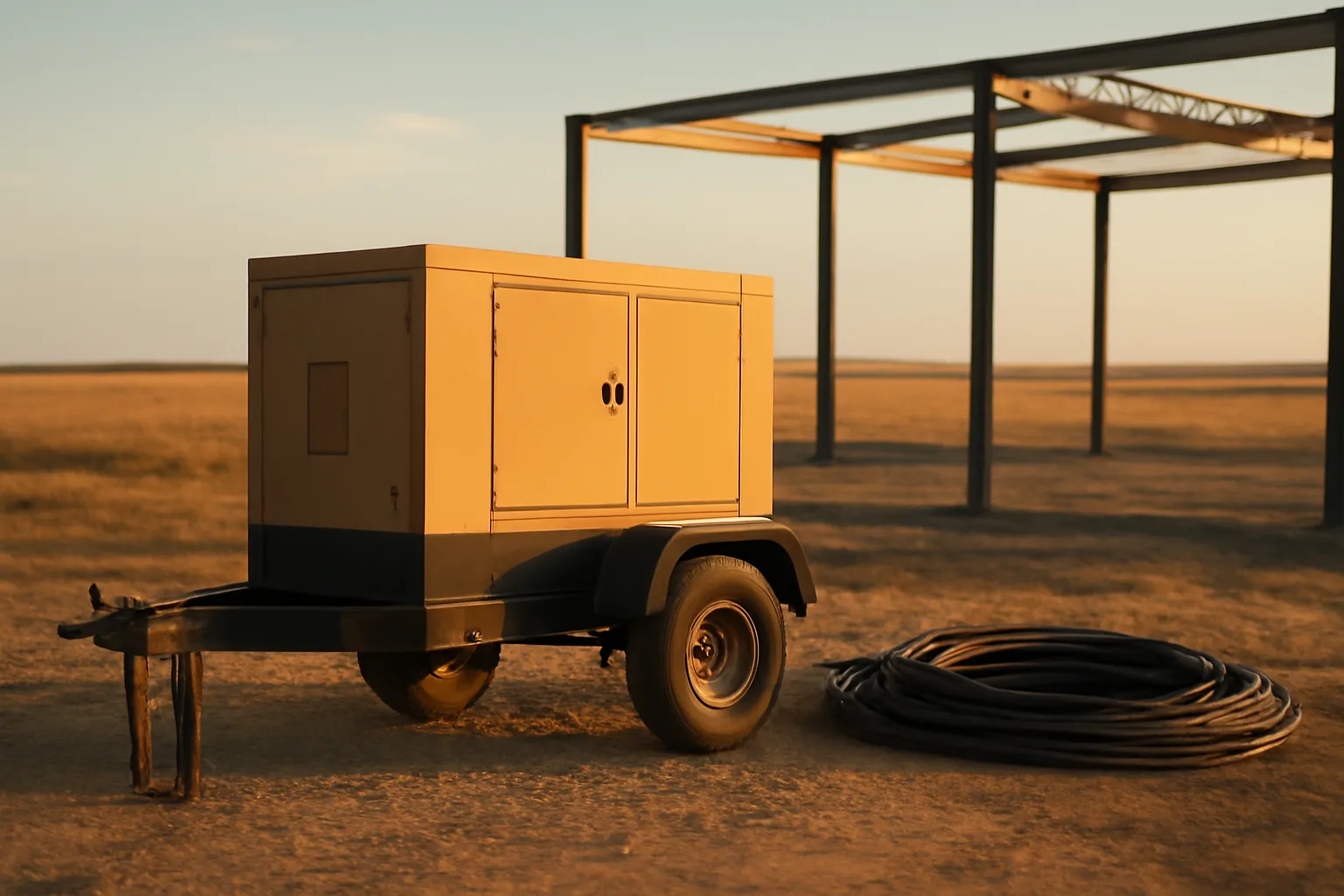
TL;DR
Kansas issues no statewide temp power or electrical contractor license. Start with a Secretary of State entity, a free IRS EIN, and a KDOR sales tax account, because rentals are taxable. If you land conductors or a temp service, pull the city or county electrical card for that job. Cities use the K.S.A. 12-1525 standard exam. Confirm every fee with the board that collects it.
How do you start temp power in Kansas?
You start temp power in Kansas by forming a business the Secretary of State recognizes, getting a free IRS EIN, opening a Kansas Department of Revenue sales tax account, buying insurance a GC will accept, then adding only the city or county electrical cards that match the work you actually touch. There is no Kansas temp power license. Do not buy a national certificate and call it done.
I would run it in that order. Entity and EIN in week one. Sales tax account before the first invoice. Insurance quotes before you take delivery of a generator. The electrical card comes next, and only if you will terminate conductors, build distribution, or request temporary service from a utility. Drop a trailer set and let the GC's electrician land it, and you are in equipment rental, not electrical contracting. Those are different paper piles.
Kansas lets cities and counties license electrical contractors. The state wrote a standard exam rule so those local cards can move. K.S.A. 12-1525 says, "The following examinations shall be used by cities and counties in this state for the purpose of determining the qualifications of persons seeking licensure as electrical, mechanical or plumbing contractors." [1] Once you hold one qualifying local license built on that exam path, K.S.A. 12-1526 is the statute other Kansas cities are supposed to honor when you apply and pay their fee. [2] That is the real license path. Local first. Then portable inside Kansas. No single state wallet card exists.
Work a border state already? How to start temp power in Arkansas and how to start temp power in Colorado are different piles. Kansas does not care what a national blog said.
Pick an entity that matches how you will own the iron. Most small shops use an LLC. File it with the Kansas Secretary of State and keep a Kansas registered agent. Confirm the current filing method and fee on the SOS business pages before you pay a third-party former. Then get the EIN online from the IRS. It costs $0. Anyone charging you for the EIN is selling a form you can submit yourself. [8]
How much does temp power cost in Kansas?
The paper cost to open a temp power Kansas shop is a handful of state filings plus insurance, and every dollar amount that is not printed in statute needs a live confirm. Kansas state sales tax is 6.5% under K.S.A. 79-3603. [3] [4] Local city and county sales taxes stack on top. Combined rates move by address, so you pull the KDOR rate for the site, not a memory of Wichita from three years ago.
I will not invent an SOS filing fee, a Wichita electrical card fee, or an Evergy temporary-service deposit. Those numbers change, and they are not one statewide price. Confirm them with the office that cashes the check. The IRS EIN is free. [8] A registered agent, a basic operating agreement, and a business bank account are ordinary first-week costs. Insurance is the line that surprises people. General liability, hired and non-owned auto, inland marine on the generators, and commercial auto on the truck will dwarf the state filing receipts. Nobody publishes a clean Kansas premium table for generator rental. Get three quotes. If a number looks cheap, read the equipment schedule.
Customer-facing temp power pricing is a different question. Utility temporary service is a tariff plus a deposit plus an inspection of the temp pole or pedestal. Evergy, Midwest Energy, and the rural electric co-ops do not share one price. Construction generator rental rates move with diesel, utilization, and whether the set is 208Y or 480Y. I will not fake a weekly 20 kW number. Bid your actual iron and your actual fuel plan.
Workers compensation is the other money question. K.S.A. 44-505 is the statute that decides who must carry it. [5] Shops still budget around a $20,000 gross annual payroll trigger that Kansas materials have long tied to that act, with listed exceptions. Amendments happen. Confirm the live exemption text with Kansas DOL before you go bare. Even if the statute would let a tiny shop skip it, many GCs will not let you on the gate without a cert.
| Paper item | Who issues it | What it does not do |
|---|---|---|
| Secretary of State entity | Kansas SOS | License electrical work |
| EIN | IRS | Replace the KDOR account |
| Retailers' sales tax | KDOR | Replace a city electrical card |
| Electrical contractor license | City or county | Cover every Kansas job by itself |
| Certificate of insurance | Carrier | Satisfy KDOR or the SOS |
Do you need a license for temp power in Kansas?
You need a local electrical contractor license when your temp power work is electrical contracting. You do not need a statewide temp power license, because Kansas does not issue one. The split is practical. Renting a trailer generator is equipment rental. Landing the service, building 480V distribution, or making up feeder cable for a construction service is electrical work the AHJ can regulate.
Cities and counties that license electrical contractors are supposed to use the standard examinations in K.S.A. 12-1525. [1] Hold a qualifying license in one of those jurisdictions and K.S.A. 12-1526 says you are entitled to a license in another Kansas city or county after you submit a complete application and pay that jurisdiction's fee, under the terms it imposes on its own applicants. [2] Read that last clause. They can still make you fill their form, show insurance, and pay. They are not supposed to make you sit a different exam.
I would get the card in the metro where the work actually is. Wichita, Overland Park, Olathe, Kansas City in Wyandotte County, Topeka, and Lawrence are the names that show up on first-year calendars. Smaller counties sometimes have no contractor license and only a permit plus inspection. Call the building department for the job address. Do not guess from a map.
Hold a card in Texas? It does not become a Kansas card. Read temp power license in Texas so you stop mixing the two files. Same warning for temp power license in Colorado. Reciprocity talk is cheap. The Kansas statute that matters is 12-1526, and it is city-to-city inside this state. [2]
A PE stamp from the Kansas State Board of Technical Professions is not the ordinary path for a rental shop. You need that world if you are sealing engineered drawings. Most first-year temp power work is not that.
How long does temp power take in Kansas?
The entity and tax IDs can be short. The electrical card and the utility temp service are the slow pieces, and nobody honest will promise you a date. Online IRS EINs often come back the same day. [8] Kansas SOS online entity filings are frequently faster than paper. Confirm current processing with SOS. I will not print a turnaround, because that is exactly the kind of number that goes stale and then gets repeated as fact.
KDOR sales tax registration is an account you want in hand before you invoice. Online systems move in days when the application is clean. Confirm with KDOR. Do not advertise a rental rate until you know how you will code the tax.
The long pole is usually the electrical exam and the first city application. Exam seats, score posting, insurance certificates, and a local review can eat weeks. After that, additional Kansas cities on the 12-1526 path are paperwork and a fee, not another test, if you stay inside the statute. [2] Still confirm. A clerk in a small town may not have run that statute this month.
Utility temporary service is its own clock. Application, construction of the temp pole or pedestal, AHJ inspection, then the utility set. Storm week in Sedgwick County is not the same as a quiet Tuesday in a college town. No approval guarantee. Build slack into the job, not into a blog timeline.
What Kansas state filings come first?
File the entity, then the EIN, then the KDOR tax accounts. That order keeps your contracts, your bank, and your invoices from fighting each other. The Secretary of State filing creates the legal person that will own the generators. The EIN is how the IRS knows that person. [8] The KDOR retailers' sales tax account is how Kansas taxes the rental of tangible personal property. [4]
Hiring W-2 employees? Add Kansas withholding with KDOR and unemployment insurance status with Kansas DOL under the Employment Security Law, K.S.A. 44-703. [12] [14] Confirm the current dollar and week tests with DOL. I am not printing a wage threshold that may have moved. Owner-only shops without employees often skip withholding and UI until the first hire. Confirm that too. A spouse on payroll changes the answer.
Skip the paid "registration services" that resell free federal forms. The EIN application is on IRS.gov. [8] Skip the impulse to form in Delaware or Wyoming for a shop that will live in Johnson County. You will still register in Kansas to do business here, and you will still collect Kansas tax. Extra states mean extra annual reports. That is a waste of money for a first-year rental yard.
Keep PDF stamps of every acceptance page. Inspectors and GCs will ask for insurance first. Banks and KDOR will ask for the EIN and the entity docs. You want those files named and dated, not buried in a personal email.
Which city or county electrical card do you actually need?
You need the card for the AHJ that will inspect the work, not a card for the state as a whole. Start with the building department on the job's postal address. Ask three things. Do you license electrical contractors. Do you accept the K.S.A. 12-1525 exam path. What insurance limits sit on the application. Write down the clerk's name. That note will matter later.
Johnson County and Wyandotte County work in year one? I would sit the standard contractor exam and apply in one of those cities first, then use K.S.A. 12-1526 to pick up the neighboring cards. [1] [2] A Wichita yard serving Sedgwick County and the surrounding towns starts in Wichita. Do not collect ten licenses before you have one truck. Each card is a renewal chore.
Some rural counties will permit a temporary pole on the strength of a licensed electrician's name and an inspection. That can be a journeyman or a contractor the county already knows. It is not a loophole you should market. It is a local practice you confirm job by job.
Watch the work description on the application. "Generator rental only" and "temporary electrical installation" are different boxes. Land a 480V service and you are in the second box. If your ads promise turnkey temp power, budget the contractor cards. If you want a cleaner rental-only shop, put it in the contract that the customer's electrician makes the connections.
Does Kansas tax generator rentals, cable, and diesel?
Yes on the rental, usually. Kansas taxes the retail sale of tangible personal property, and KDOR treats leases and rentals of that property as taxable unless a specific exemption fits. [3] [4] State tax is 6.5%. Local tax is extra and is site-specific. [3] Charge tax on the rental invoice unless counsel or KDOR has told you a written exemption applies. Resale certificates and exemption certificates are paper you keep, not a vibe.
Parts, pigtails, and cable you sell outright are taxable the same way. Labor-only billing can be a different conversation, and I would not invent a split on a blog. Bundle a generator, cable, and a tech visit on one line, and expect KDOR to look at the whole charge. Clean invoices now beat a later assessment.
Diesel is its own pile. Highway fuel and off-road dyed fuel are not interchangeable just because both come out of a tank on your lot. Motor fuel tax sits with KDOR. Federal rules sit with the IRS. Store diesel in drums or tanks, and count the gallons. SPCC under 40 CFR 112 can apply once aggregate aboveground oil storage in containers of 55 gallons or more reaches 1,320 gallons. [10] That number is federal and real. A farm-style transfer tank and three 55-gallon drums add up faster than people think.
I keep cable cut sheets, fuel tickets, and 480V one-line sketches in one folder, because that is the pile inspectors actually ask to see. TempPowerPath has a $179 one-time Cable + Fuel + 480V Kit if you want that stack pre-sorted. A binder you build yourself works fine too.
What OSHA rules hit temporary wiring on a Kansas jobsite?
OSHA construction electrical rules apply on Kansas jobsites the same way they apply in every other state. The two sections shops actually get cited on are 29 CFR 1926.404 and 1926.405. [6] [7] Ground-fault protection is not optional theater. OSHA 1926.404(b)(1)(i) says, "The employer shall use either ground-fault circuit interrupters as specified in paragraph (b)(1)(ii) of this section or an assured equipment grounding conductor program as specified in paragraph (b)(1)(iii) of this section to protect employees on construction sites." [6]
I would ship GFCI protection as the default and treat an assured grounding program as extra paper you only run if you truly run it. A binder nobody tests is not a program. Temporary wiring methods, strain relief, and covers sit in 1926.405. [7] Broken knockouts and daisy-chained cubes are how small shops get famous for the wrong reason.
The local AHJ will also enforce the NEC edition it adopted. Kansas does not hand you one statewide building code for every town. Ask the inspector which NEC cycle they are on before you build a 480V rack to last year's habit. Article 590 is the temporary installations article in the NEC. Your copy should match the city, not your supplier's catalog.
Send techs onto someone else's site and you are in the employer box, even when the GC thinks you are "just the generator guy." Label the distro. Use listed gear. Do not hand a millwright a homemade spider that would embarrass a first-year apprentice.
When does a portable generator become a stationary engine?
A set that stays put long enough can leave the portable world and enter EPA stationary engine rules. 40 CFR 63 Subpart ZZZZ is the RICE NESHAP. The practical tripwire shops talk about is a location stay of more than 12 consecutive months, with a shorter seasonal-source rule in the same definitions. [9] Confirm the current definition in the eCFR before you leave a plant a set for a year and a day.
Most true construction rentals never hit that test. The jobs that do are the quiet ones. A backup set that "temporarily" lives behind a grain elevator. A quarry that keeps your 350 kW through two winters. Write the off-rent date in the contract. Visit the site. If the customer wants it permanently, that is a different sale and a different air file.
Kansas Department of Health and Environment can have its own air construction or operating questions on larger or long-stay engines. I will not invent a horsepower cutoff. Call KDHE with the engine family, fuel, and expected stay. Portable construction use is often a shorter conversation than a stationary prime-power install. Still have the conversation before the twelfth month.
Do not paint over the EPA exhaust label. Do not pull a catalytic converter to "get more power." That is how a cheap job becomes a federal one.
What insurance and workers comp do you need the first year?
You need whatever the GC, the city application, and Kansas DOL each demand, and those three lists are not the same. No statewide statute says a generator shop must carry $1 million per occurrence. That number is contract custom. I would still buy it if you want commercial work. I would add inland marine that lists each serial number. A GL policy that excludes the iron you roll off the lot is a policy you paid for and cannot use.
Commercial auto and trailer physical damage matter more than people admit. The loss is often on the highway, not on the pad. If you use employees' pickups, ask about hired and non-owned auto. Confirm with the agent. Do not take a Facebook answer.
Workers compensation follows K.S.A. 44-505 and the Kansas DOL reading of it. [5] The commonly cited $20,000 gross annual payroll trigger is the figure shops still plan around, with exceptions written in the act. I am hedging because the exemption list is exactly where legislatures tinker. Confirm it. If you have employees walking jobsites, budget a policy even while you wait for the statutory answer. Assigned risk exists if the voluntary market shrugs.
Certificates should name the GC and the owner as additional insured when the contract says so. Waiver of subrogation shows up on every decent set of terms. Build those endorsements into the quote. Adding them the night before mobilization is how you learn what "minimum earned premium" means.
How do you get temporary utility service on a Kansas site?
You apply to the serving utility, build what that utility's temp-service standard shows, get the AHJ to inspect it, then wait for the set. Evergy covers a large share of eastern Kansas. Co-ops cover huge rural stretches. Midwest Energy and other investor-owned or municipal systems fill the rest. There is no statewide temp-power desk.
The utility will want an application, a site contact, load, voltage, and often proof that a licensed electrician is responsible for the pedestal or overhead temp pole. That last item is why a rental-only shop still ends up talking about city electrical cards. If your customer expects you to "just get the meter set," you have left pure rental.
I would read the serving utility's current temporary service standard before you buy a panel. Height, guy, grounding, and socket type are not folk wisdom. A pedestal that passed in one co-op territory can fail ten miles down the road. Deposits and construction charges live in the tariff. Confirm them. I will not invent a dollar figure.
Off-grid site, or an ugly utility lead time? A generator is the product. Say that out loud in the bid. A lot of bad temp power Kansas jobs start with a promise that the utility would be there Friday.
What first-year spending is a waste of money?
Buying a 400 kW 480V set in month one is the classic waste. You will finance steel that sits while you learn how Kansas GCs actually rent. Start with a couple of small towables you can hang 208 and 240 on, plus enough cable to look serious. Add 480V when a real purchase order needs it.
Paying a license mill to "get you a Kansas electrical license" is the next waste. There is no statewide card to buy. You sit the standard exam and you apply to cities. [1] [2] A coach for the exam can be worth it if you have been out of the trade. A packet that promises a state license is smoke.
Forming in another state to look sophisticated is a waste. So is a wrap truck before you have a second set. So is a custom shop building when a fenced lot and a conex will do. Spend on insurance, on listed distribution, and on a truck that can tow the weight you actually own.
Towing heavier trailers? Ask whether you need a CDL and whether KCC or FMCSA wants a USDOT number for the way you operate. Interstate commercial motor vehicles are the clean FMCSA case. [11] Intrastate facts are messier. Confirm before you guess. A ticket on I-70 is more expensive than a phone call.
How do you confirm board-level facts before you pay anyone?
You confirm with the office that takes the money, using the job address and your real work description. Secretary of State for the entity and the current filing fee. KDOR for sales tax, local rates, withholding, and motor fuel. [4] [14] Kansas DOL for unemployment status and workers compensation coverage questions. [5] [12] The city or county building department for the electrical card, the bond, and the permit. The serving utility for the temp-service standard and deposit. KDHE if a set will sit past a construction season. [9]
Print the page or save the PDF the day you rely on it. Statute text lives at the Kansas Revisor. [1] [2] [3] [5] OSHA and EPA text lives on the federal sites. [6] [7] [9] [10] If a salesperson's number disagrees with those pages, the pages win.
Other state guides are useful only as contrast. How to start temp power in Tennessee and how to start temp power in Alabama will not pull a Wichita permit. How to start temp power in Arizona is the same warning in a drier climate.
Want this path as a kit? It lives at /start. TempPowerPath is an independent publisher, not a law firm and not a service company. Nothing here is an approval, a fee quote, or a timing promise. Confirm it anyway.
Frequently asked questions
Do you need a license for temp power in Kansas?
You need a city or county electrical contractor license if you land conductors, build distribution, or pull a temporary utility service. Kansas does not issue a statewide temp power license. Pure generator rental, with the customer's electrician making connections, is usually a tax-and-insurance problem, not a state license problem. Confirm the AHJ on the job address.
How much does temp power cost in Kansas?
State sales tax is 6.5% under K.S.A. 79-3603, plus local tax that changes by site. Entity, card, and utility deposit fees must be confirmed with SOS, the city, and the utility. I will not invent those. Insurance will outrun the filing receipts. Customer rental rates depend on kW, voltage, fuel, and term, and there is no honest statewide price list.
How long does temp power take in Kansas?
EINs can come back the same day. SOS and KDOR online accounts often move in days when the filing is clean. Confirm current queues. The electrical exam and first city card are the slow step and can take weeks. Utility temp service waits on construction and inspection. Nobody can promise an approval date.
Is there a statewide Kansas electrical contractor license?
No. Cities and counties license electrical contractors. K.S.A. 12-1525 requires those jurisdictions to use standard examinations. K.S.A. 12-1526 is the in-state path to pick up additional city or county cards after you hold one qualifying license and pay the new jurisdiction's fee. Confirm each city's application packet.
Can one city card cover every Kansas job?
No. The first card covers that AHJ. Other Kansas cities are supposed to issue you their license under K.S.A. 12-1526 after a complete application and their fee, on the same terms they give their own applicants. You still apply. Rural counties with no contractor license still have permits and inspections. Ask the building department for the address.
Do I charge Kansas sales tax on generator rentals?
Usually yes. KDOR taxes retail sales and the rental of tangible personal property unless a written exemption applies. The state rate is 6.5%. Local rates stack by location. Keep exemption certificates in the job file. Bundle labor and equipment on one taxable line only after you know how KDOR will read it.
Do I need a CDL or a USDOT number to tow generators?
Maybe. Weight, combination, air brakes, and interstate versus intrastate use decide it. FMCSA explains when a USDOT number is required for commercial motor vehicles. Kansas CDL rules sit with the state's driver license agency. Confirm before you tow a heavy trailer for hire. Guessing on I-70 is expensive.
Can I run the shop as a sole proprietor with no SOS filing?
You can operate in your own name, but you still need tax accounts if you are renting property, and you get no entity veil. Most shops still file an LLC with the Kansas Secretary of State because banks, GCs, and insurers expect it. Confirm current SOS methods and fees. An EIN is still wise, and it is free from the IRS.
Do I need a Kansas PE stamp for temp power?
Not for ordinary generator rental and listed temporary distribution. You need a licensed professional engineer if you are sealing designed electrical drawings. That is the Kansas State Board of Technical Professions world, and it is a different career than a first-year rental yard. Do not pay for a PE stamp you cannot use.
When does EPA treat my portable set as stationary?
Subpart ZZZZ looks at engines that remain at a location more than 12 consecutive months, with a shorter rule for seasonal sources. Read the current eCFR definition. A six-week house job is not that. A set that quietly lives behind a plant for a year can be. Put an off-rent date in the contract and keep a site log.
What if I only rent generators and never land conductors?
Then your first pile is the SOS entity, EIN, KDOR sales tax, insurance, and fuel rules, not an electrical contractor card. Write the connection duty into the rental contract so a GC cannot slide landing work onto you mid-job. If your ads say turnkey temp power, budget the city cards anyway, because that is the work customers will ask for.
Do rural electric co-ops follow the same temp service rules as Evergy?
No. Each utility has its own temporary service standard, deposit, and socket spec. Co-ops cover a lot of Kansas dirt. Read that co-op's current temp-service sheet and ask which AHJ inspects the pole. A pedestal that passed in Evergy territory can fail ten miles into a co-op. Confirm before you buy the panel.
Is workers compensation required if I have no employees?
Owner-only shops often fall outside employee-based workers compensation, but K.S.A. 44-505 and Kansas DOL control that call, and GCs still ask for certificates. Confirm the live payroll trigger and exceptions before you skip a policy. If you hire one laborer, revisit DOL the week you hire, not the week someone gets hurt.
Does a national generator-rental certificate replace Kansas paper?
No. Manufacturer training is useful. It is not a Kansas electrical contractor license, not a KDOR tax account, and not an SOS entity. Cities that license electrical work look at the K.S.A. 12-1525 exam path and their own application. Bring the national card to a jobsite as a resume line, not as a permit.
Sources
- Kansas Revisor of Statutes, K.S.A. 12-1525: Kansas cities and counties must use the standard examinations to license electrical, mechanical, or plumbing contractors.
- Kansas Revisor of Statutes, K.S.A. 12-1526: A person licensed by one Kansas city or county on the standard exam path is entitled to a license in another Kansas city or county after a complete application and that jurisdiction's fee.
- Kansas Revisor of Statutes, K.S.A. 79-3603: Kansas imposes retailers' sales tax at the state rate of 6.5% on taxable retail sales and listed services.
- Kansas Department of Revenue, Sales Tax: KDOR administers retailers' sales tax registration and collection for Kansas businesses, including taxable rentals of tangible personal property.
- Kansas Revisor of Statutes, K.S.A. 44-505: K.S.A. 44-505 is the statute that sets when the Kansas Workers Compensation Act applies to employments in the state, including listed exceptions.
- U.S. OSHA, 29 CFR 1926.404: Construction employers must protect employees with GFCI devices or an assured equipment grounding conductor program.
- U.S. OSHA, 29 CFR 1926.405: OSHA sets temporary wiring methods and related wiring construction requirements on construction sites.
- IRS, Apply for an Employer Identification Number (EIN) Online: Businesses can apply for an EIN online at no cost from the IRS.
- U.S. eCFR, 40 CFR 63 Subpart ZZZZ: Stationary reciprocating internal combustion engines, including engines that remain at a location more than 12 consecutive months, fall under the RICE NESHAP.
- U.S. eCFR, 40 CFR 112.1: SPCC requirements can apply when aggregate aboveground oil storage capacity in qualifying containers reaches 1,320 gallons.
- FMCSA, Do I Need a USDOT Number?: FMCSA states when operators of commercial motor vehicles must obtain a USDOT number.
- Kansas Revisor of Statutes, K.S.A. 44-703: K.S.A. 44-703 defines employer and related terms under the Kansas Employment Security Law for unemployment insurance.
- Kansas Revisor of Statutes, K.S.A. 79-3602: K.S.A. 79-3602 defines retailers, tangible personal property, and related sales-tax terms used to tax Kansas retail transactions.
- Kansas Department of Revenue, Withholding Tax: Kansas employers that pay wages register for state withholding tax with KDOR.