Last updated 2026-08-21
TL;DR
Starting temp power in Delaware is a licensed electrical trade plus ordinary state paper. If you make up conductors or advertise the work, you need the matching license from the Board of Electrical Examiners. File the entity with the Division of Corporations, get a Division of Revenue business license, and add local permits and a utility or generator plan. Confirm every fee and date with those desks. No one can honestly guarantee approval time.
What does starting temp power in Delaware actually mean?
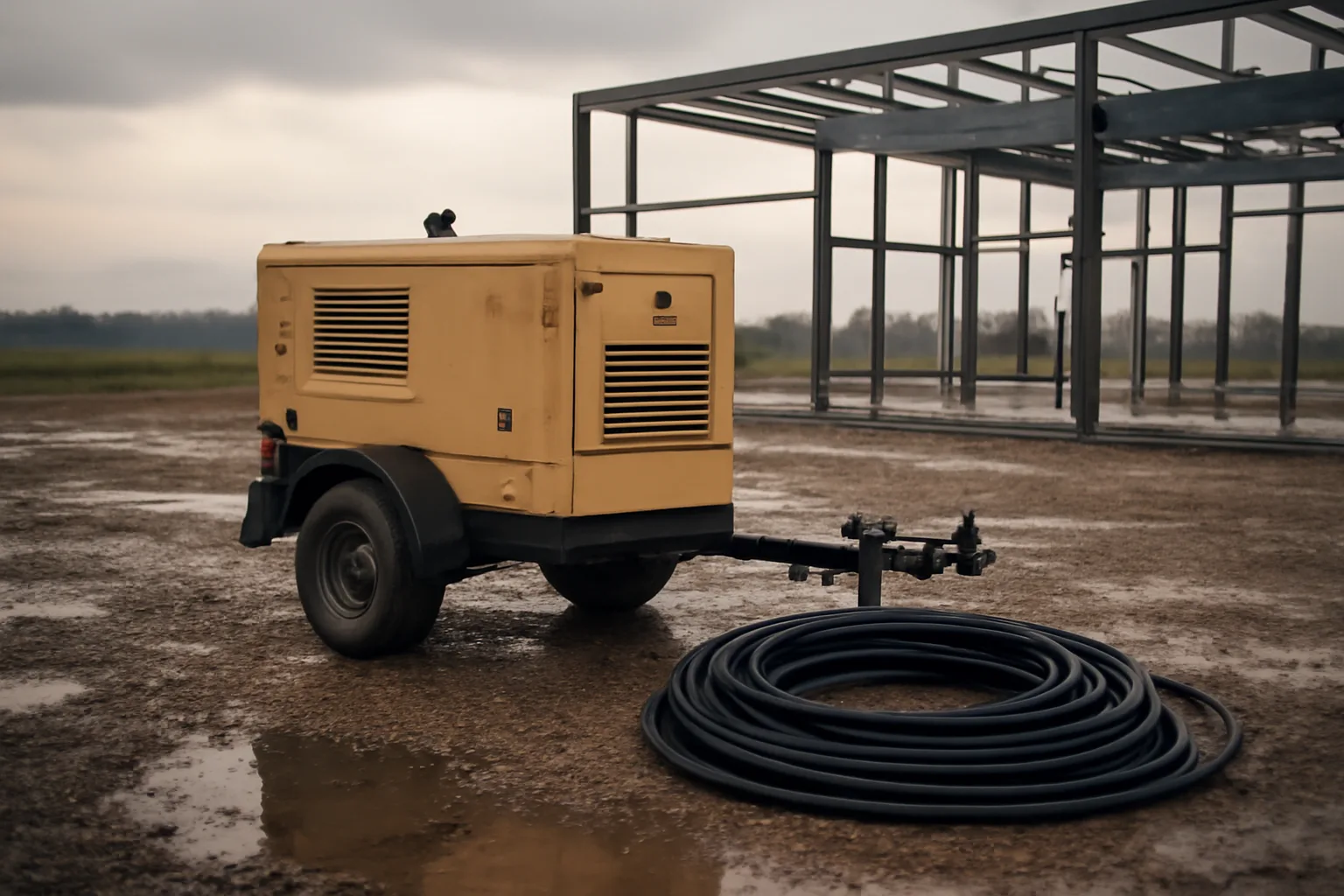
Starting temp power in Delaware means you plan to supply temporary electrical power. That can be a construction temp service, an event distro, a planned outage generator, or a 480V yard that is not on a finished building service. The gear is the obvious part. Generators, temp panels, feeder cable, spider boxes, ground rods, and sometimes a utility temp meter rack.
The legal wrapper is electrical work. If you land conductors, build a temp service, or tell the public you provide electrical hookup, you are inside Title 24, Chapter 14 [1]. Buying a trailer generator does not create a loophole. I have no patience for the myth that temp means unlicensed.
Think in layers. License from the Board of Electrical Examiners. Entity and tax paper from the Division of Corporations and the Division of Revenue. Insurance that actually names the iron. Then the local permit and either a utility ticket or a standalone generator plan.
I would start as a licensed shop with rented iron. I would not start as a Facebook page with a tired 20 kW unit and a hope.
Stay in a pure rental lane only if you never make electrical connections. The second you torque a lug, the license question is settled [1][2]. On a construction site, OSHA still sees construction electrical work, not a special Delaware exception [8][9].
Do you need a license for temp power in Delaware?
Yes, for almost every real temp power job. Delaware puts electrical services under the Board of Electrical Examiners in Title 24, Chapter 14 [1]. The Board's operating rules sit in 24 DE Admin. Code 1400 [2].
If you install, maintain, or hold yourself out as qualified to do electrical work, you need the license class that matches that work. Master, limited, journeyperson, and apprentice classes exist. The live class list, the experience evidence they want, and the exam steps are on the Division of Professional Regulation electrician pages [3][4]. Read those pages. Then confirm anything that looks stale.
I would plan on a master path if the goal is to run a firm and pull permits. A limited class can be enough for a narrow, named scope. That is a board question. Ask it with the actual work described, not with the vague phrase temp power.
Holding out matters. Ads, truck lettering, and invoices that offer electrical hookup are public claims. Chapter 14 is written around the work and the claim [1]. A cheap weekend job is not cheap if you cannot collect or you eat a stop-work order.
A Maryland or Pennsylvania card is not a Delaware card. Reciprocity, if any exists for your class, is a board decision. Get it in writing before you bid a Newark or Rehoboth job.
Fees, exam vendors, and review times move. The new license page and the exam page are the source, not a group chat [3][4]. If the PDF and the portal disagree, call the Division. I would not invent a processing week for you, and you should not invent one for a customer.
If you already hold the right Delaware license, you are not starting from zero. You are adding a service line and the rest of the business paper.
What business paper do you file first in Delaware?
File the entity before you print shirts. Most people use a Delaware LLC. You file a Certificate of Formation with the Division of Corporations, and you need a Delaware registered agent [5]. That agent is not a mailbox gag. It is the statutory address for service of process.
Delaware LLCs pay a $300 annual tax according to the Division of Corporations franchise tax page [6]. Confirm the due date and any annual report step on that same page before you ignore a letter. Formation filing fees are published by the same division. Confirm the live Certificate of Formation amount before you pay [5].
Get an EIN if you need one for a bank account or for hiring. An EIN is $0 through the IRS online application [10].
Then open the Division of Revenue business license. Delaware runs a business license and gross receipts tax system. It does not run a general state sales tax [7][13]. Confirm the license category that matches electrical or contracting work, and confirm the current tax, on the Revenue page [7]. I would not send a GC invoice before that license exists.
If you hire anyone, read Title 19, Chapter 23 before they step on a site [11]. Officer election rules can apply to some entities. Confirm those with a carrier who knows Delaware, not with a national web form that thinks every state is the same.
I would keep one clean entity. Three stacked LLCs before the first inspection is a waste of money.
Want a different state stack for comparison? The order in how to start temp power in Alabama is not the Delaware order.
How much does temp power cost in Delaware?
There is no single temp power price in Delaware. You have paper cost, insurance cost, iron cost, and labor. They do not move together.
Paper is the only pile with official dollar figures. Delaware LLCs pay a $300 annual tax (Division of Corporations franchise tax page) [6]. Confirm the current Certificate of Formation amount on the how-to-form materials before you pay [5]. Board application and renewal fees are board-confirmable on the electrician pages [3]. The Division of Revenue business license amount is on the Revenue site [7]. An EIN is $0 through the IRS online application [10].
Insurance will dwarf the filings. General liability is table stakes. Auto and trailer coverage is next because you will tow. Inland marine covers the generators when they sit on someone else's dirt. Workers' comp applies when you have staff [11]. I would not shop these only on premium. Read the additional insured wording and the equipment valuation clause.
Iron is the swing item. A small 120/240 package for punch-list tools is one budget. A 480V feeder, cam-lok set, ground kit, and a large towable diesel is another. I would rent the large set in year one. Buying a high-hour machine because the auction price looks friendly is how you fund a shop rebuild.
Labor should assume licensed rates. If a bid only works with unlicensed labor, the bid is wrong.
Customer pricing for a weekend event or a six-month temp service is local. Nobody has a clean statewide rate card. Price permit time, fuel, delivery, after-hours call-back, and a failed first inspection. Then keep margin.
| Cost block | What you are paying | How to treat the figure |
|---|---|---|
| State entity tax | LLC annual tax | $300 on the franchise tax page [6] |
| Formation and board fees | Certificate of Formation, electrician application | Confirm live amounts [3][5] |
| State business license | Division of Revenue license and gross receipts | Confirm on the Revenue page [7] |
| Federal ID | EIN | $0 on the IRS application [10] |
| Insurance | GL, auto, inland marine, WC | Quote it. Do not guess. |
| Equipment | Generators, cable, distro, grounds, fuel | Rent first unless the calendar is full |
For another state's budget notes, see temp power cost in Tennessee.
How long does temp power take in Delaware?
How long temp power takes in Delaware is not one number. It is a stack of clocks, and none of them owe you a promise.
The LLC filing can be quick when the Certificate of Formation is clean. The Division of Corporations publishes filing choices on the how-to-form page. Confirm current options there [5]. I still would not schedule a Monday meter set on a Friday entity idea.
The license is the slow clock if you do not already hold one. Documented experience, an exam, and board review all sit on that path [3][4]. If you still need hours under a licensee, you are not opening a temp power firm this quarter. You are getting legal hours. That is the honest sequence.
Insurance can be days if your loss history is simple. It stretches when you want rental wording and installation wording on one policy.
Permits follow the county or city desk that actually owns the lot. Utility temp service follows design review, payment, and a line crew. Generator-only jobs move faster once the permit and grounding are right. Utility temp racks wait on the utility.
Anyone who sells a fixed launch week is guessing. Confirm process, not folklore. Build slack into the first three jobs.
The first failed inspection is a teacher. It is also a delay.
What insurance do you actually need for Delaware temp power?
Carry general liability before you roll a truck. GCs will ask for a certificate, additional insured status, and sometimes a waiver of subrogation. Have your agent read the bid exhibit. Construction and equipment rental wording is not the same as an office policy.
Auto and trailer coverage is easy to underdo. Temp power is towing and drop-off. Inland marine or an equipment floater is what pays when a unit walks off a Saturday site. I would not skip it to save a few hundred dollars.
Workers' compensation is required territory once you have employees under Title 19, Chapter 23 [11]. Confirm officer elections. Confirm who counts as an employee. A helper you pay in cash is still a people risk.
Do not buy a random license bond until a spec or a public owner asks for a named form. Then buy that form.
If a carrier will not understand 480V distro, find another carrier. The cheap binder is a waste of money when the exclusion appears after the claim.
How do Delaware permits and inspections work for temp power?
Permits are local. Delaware has three counties, and several cities run their own inspections. New Castle County Licenses and Inspections is the northern desk most people meet first [12]. Kent and Sussex run their own inspection shops. Wilmington, Newark, Dover, and other towns can require a city permit even after you already talked to the county.
Temp electrical service usually needs an electrical permit. A pedestal, trench, or platform can pull a building permit too. Ask before you fabricate.
Bring a one-line, load math, grounding plan, and the qualifying licensee's information. Inspectors are not there to design your rack. Showing up with a generator and a shrug wastes the trip.
A county sticker does not cover a city lot. Check the political boundary. It sounds petty. It is how stop-work orders get written.
If you work south, do not assume a beach-town process matches New Castle County [12]. Call that office. Write down the name of the person who told you the permit type.
What do Delaware utilities want for temporary service?
Grid temp service is a utility product, not a board product. Delmarva Power covers a large part of the state. Delaware Electric Cooperative and several municipal systems cover other towns. Each one has a construction or temporary service process.
You will submit load, a site sketch, a requested date, and money. They will specify the temp rack, the meter socket, and working space. I would get those rules before I cut strut. Fabricating the wrong rack is a quiet way to lose a week.
Generator jobs still touch the utility when you land on an existing service or use a transfer switch. That is not a casual cam-lok onto a meter can. Isolation and interconnection rules exist for a reason.
If two utilities and a city all touch one campus, pick a single point of contact and write the one-line so a stranger can read it.
Do not promise a drop date the utility has not accepted. I would rather lose the job than invent a crew day.
What OSHA and fuel rules hit temp power first?
Construction temp power is an OSHA job, more than a board job. 29 CFR 1926.405 states, "Temporary electrical power and lighting wiring methods may be of a class less than would be required for a permanent installation." [8] The rest of Subpart K still applies.
29 CFR 1926.404 requires GFCI protection or an assured equipment grounding conductor program on construction sites [9]. I use GFCIs. Assured grounding programs die when the tester is in another truck.
Cord, strain relief, wet-location covers, burial, and 480V clearances are the daily details. People get hurt on the boring parts. House wire used as feeder is a tell that the shop is not ready.
Fuel is part of the plant. A few cans is one problem set. A skid tank is another. If aboveground oil storage gets large enough, EPA SPCC rules in 40 CFR 112 can apply. Confirm the current applicability thresholds in that part before you park a bulk tank [14].
This is where a field list earns its keep. I keep a cable, fuel, and 480V checklist so grounding and refuel steps are not memory. TempPowerPath publishes a $179 one-time Cable + Fuel + 480V Kit if you want that bundle. A marked notebook is fine if you actually use it.
Compare a longer code-plus-license stack in how to start temp power in California if you also bid west.
What does first year paper look like after you open?
First year operations are a calendar. License renewal and continuing education follow 24 DE Admin. Code 1400. Confirm the current hour count and approved providers in that chapter before you buy a class [2].
Delaware LLCs pay a $300 annual tax on the Division of Corporations schedule [6]. Revenue filings follow the business license and gross receipts calendar [7]. Put both on a reminder you will actually see.
Keep a job file. Permit, inspection result, one-line, certificate of insurance, utility ticket, fuel receipts. GCs ask twice. Some owners ask after the trailer leaves.
Stay rental-heavy until the work repeats. Hiring before workers' comp and a supervisor plan exist is how small shops walk into Title 19 trouble [11].
I would turn down work that needs a license class you do not have. That is not humility. That is staying in business.
What mistakes waste money on Delaware temp power?
The costly mistakes are dull. Bidding without a licensee who can pull the permit. Using a county permit inside a city. Skipping GFCI because the saw is only running a day. Buying a generator with no equipment coverage. Feeding a panel with the wrong cord type.
Forming extra LLCs before the first inspected job wastes money. So does wrap vinyl on an unlicensed truck.
Do not advertise emergency hookup if you cannot legally terminate at night.
If you chase work across state lines, read the other board first. The trailer does not carry the license. Start with how to start temp power in Arizona, how to start temp power in Colorado, or temp power license in Texas.
How does the Delaware path compare with other states?
Delaware is small enough that you can name the desks. Board of Electrical Examiners. Division of Corporations. Division of Revenue. County or city inspections. The serving utility. That is the whole map [1][5][7][12].
The work is still electrical work. OSHA still applies on construction sites [8][9]. Local permits still apply. I would rather lose a bid than fake a license class.
For another full state path, use how to start temp power in Tennessee.
Confirm every fee, form, and date with the office that issues it. I will not give you an approval week. I will tell you to call the board.
TempPowerPath is an independent publisher, not a law firm and not a service company. If you want the kit path, go to /start. The steps above work without it.
Frequently asked questions
Do you need a license for temp power in Delaware?
Yes for almost every job that makes electrical connections or advertises electrical service. Title 24, Chapter 14 puts that work under the Board of Electrical Examiners. Confirm the class that matches your scope on the Division of Professional Regulation electrician pages. A generator rental with no hookup is a different lane. Do not mix the lanes.
How much does temp power cost in Delaware?
Paper is the only official pile. Delaware LLCs pay a $300 annual tax on the Division of Corporations franchise tax page. Formation, board, and Revenue license amounts must be confirmed live. Insurance and generators dwarf those filings. I would rent large iron until the calendar is full. There is no honest statewide job-rate card.
How long does temp power take in Delaware?
There is no guaranteed launch date. Entity filings can be fast when they are clean. The electrician license is slow if you still need hours or an exam. Permits and utility temp service follow local desks and crews. Confirm current processing options with Corporations, the board, and the inspector. Anyone selling a fixed two-week open is guessing.
Can a handyman pull temp power without an electrician license?
Not if the work is electrical service under Chapter 14. Holding out as qualified counts too. A helper can work only in the apprentice or other lawful role the board allows. Confirm supervision rules in 24 DE Admin. Code 1400. I would not bid a temp service on a handyman card.
Do you need a Delaware LLC to run temp power?
No single entity type is mandatory, but you need a lawful business form and the tax licenses that go with it. Most people file an LLC with the Division of Corporations and then get a Division of Revenue business license. Confirm the current formation fee before you file. I would not operate on a personal name once invoices get serious.
Does Delaware charge sales tax on generator rentals?
Delaware has no general state sales tax. It uses a business license and gross receipts tax system instead. Confirm how your category is taxed on the Division of Revenue business license page. Local lodging or other special taxes are a different question. Ask Revenue if a rental invoice looks odd.
Who inspects temporary electrical service in Delaware?
The city or county that has inspection authority on that lot. New Castle County Licenses and Inspections is one example in the north. Some cities run their own shops. The utility may also look at a temp meter rack. Ask the serving jurisdiction before you set equipment.
Do you need workers' comp as a solo operator?
Title 19, Chapter 23 is written around employers and employees. A true solo setup can differ from a shop with helpers. Officer election rules exist for some entities. Confirm your facts with a Delaware-knowledgeable carrier and the Department of Labor. I would not guess on a helper paid in cash.
Can you use a Maryland or Pennsylvania electrician license in Delaware?
Not as a substitute. Delaware licenses Delaware work. Ask the Board of Electrical Examiners about any reciprocity before you bid. Get the answer in writing. A trailer with out-of-state plates does not move the license line.
What size generator needs extra fuel and SPCC paper?
Cans and small transfer tanks are mostly fire-code and site-rule problems. Larger aboveground oil storage can trigger EPA SPCC rules in 40 CFR 112. Confirm current gallon thresholds in that part before you park a bulk tank. When in doubt, ask someone who reads SPCC plans, not a parts counter.
Do event tents need the same license as construction temp power?
If you make electrical connections or hold out as an electrician, the Board still cares. Event AHJs and fire marshals add their own rules. Construction sites add OSHA Subpart K. The license question does not vanish because the load is a tent. Confirm the local permit path for that venue.
Where do you confirm current Delaware board fees?
Use the Division of Professional Regulation Board of Electrical Examiners new license and related pages. If a PDF and the portal disagree, call the Division. I would not use an old invoice or a forum screenshot. Fees move. The board page is the source.
Is a limited electrician license enough for temp power?
It can be, if the limited scope matches the work. It is not enough if you are selling full temp services and permit-pulling across building types. Describe the actual job to the board and ask. I would not stretch a limited class to chase 480V campus work.
Do you need a city of Wilmington permit too?
Wilmington and several other cities run local permit and inspection shops. A state electrician license does not replace a city permit. Check the lot's jurisdiction before you mobilize. County and city lines are where people waste a day.
Sources
- Delaware Code Title 24, Chapter 14, Board of Electrical Examiners: Delaware regulates electrical services through the Board of Electrical Examiners and requires licensure to perform or hold out as qualified to perform electrical services.
- 24 DE Admin. Code 1400, Board of Electrical Examiners: Board administrative rules cover applications, examinations, renewal, and continuing education for Delaware electrician licenses.
- Delaware DPR Board of Electrical Examiners new license page: Applications for electrician licenses are filed with the Division of Professional Regulation; current forms and class paths are published on the board new license page.
- Delaware Division of Corporations, How to Form a New Business Entity: Forming a Delaware LLC requires filing a Certificate of Formation with the Division of Corporations and maintaining a Delaware registered agent.
- Delaware Division of Corporations, Annual Report and Tax Information: Delaware limited liability companies pay a $300 annual tax.
- OSHA 29 CFR 1926.405 Wiring methods, components, and equipment for general use: OSHA allows temporary electrical power and lighting wiring methods of a class less than required for a permanent installation, with remaining Subpart K rules still applying.
- OSHA 29 CFR 1926.404 Wiring design and protection: Employers on construction sites must use ground-fault circuit interrupters or an assured equipment grounding conductor program.
- IRS, Apply for an Employer Identification Number (EIN) Online: An EIN is obtained at no charge through the IRS online application.
- Delaware Code Title 19, Chapter 23, Workers' Compensation: Delaware workers' compensation law in Title 19, Chapter 23 governs employer coverage duties when employees are hired.
- New Castle County Licenses and Inspections: New Castle County Licenses and Inspections administers building and trade permits and inspections in that county.
- Delaware Code Title 30, Chapter 21, General Provisions for Occupations and Businesses: Delaware statutes in Title 30, Chapter 21 establish the state business and occupational license framework administered with gross receipts tax.
- 40 CFR Part 112, Oil Pollution Prevention (SPCC): EPA SPCC rules in 40 CFR 112 can apply to facilities with aboveground oil storage at or above the part's applicability thresholds.