Last updated 2026-08-19
TL;DR
Indiana issues no statewide electrician license for temp power. You work through the local building or electrical official, then the serving utility. Costs and calendars are local, never a state price list. OSHA still requires GFCI protection or an assured grounding program on covered construction receptacles. Confirm fees, inspections, and lead time with the AHJ and the utility before you set a pole or order a board.
What is a temp power board in Indiana?
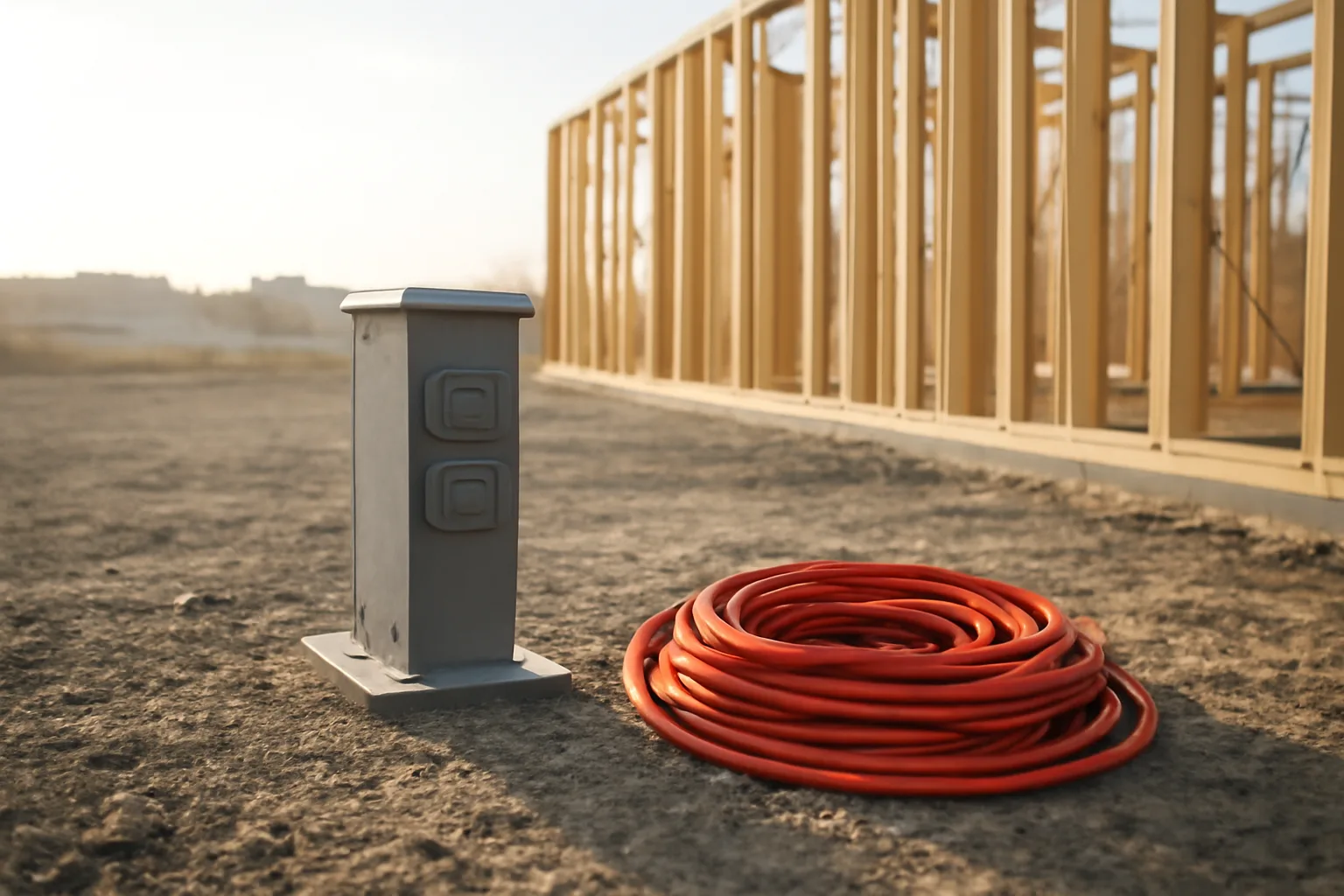
A temp power board in Indiana is the temporary electrical setup you run before permanent service goes live. In the field that means a treated pole or a pedestal, a utility meter socket, a main breaker, and GFCI-protected outlets that feed tools, a job trailer, or temporary lights. People also use "board" to mean the local building or electrical official who inspects that setup.
You will hear temp pole, temporary service, and construction power. Same job, different mouths. The utility energizes a meter. Your gear downstream of that meter is the board. Park a generator instead and you still have a temp board. You still have OSHA rules. You may still need a local permit. That last part is the part people guess wrong.
Indiana writes electrical rules at the state commission. Local departments enforce them. The Fire Prevention and Building Safety Commission adopts statewide fire safety and building laws, and the electrical code sits in that pile. [4] Your city or county inspector is the person who actually walks the pole.
I treat the metal and the paper as one path. Gear right, permit wrong, and the meter stays dark. Permit clean, grounding electrode a joke, and you fail in the gravel. Both sides have to work.
A spider box on a stand is a temp board. A 480-volt panel for a crane is a temp board. A 100-amp overhead drop to a saw shed is a temp board. Size changes. The paper logic does not.
Do you need a license for temp power in Indiana?
You do not get a statewide electrician license from Indiana for temp power. The Indiana Professional Licensing Agency issues no electrician or electrical contractor card. [9] Many cities still require a local electrical contractor license before they will take a permit. Unlicensed work stalls the inspection. Confirm with the city or county that will inspect the pole.
That split is the whole Indiana story. The state adopts a code. Cities and counties decide who may pull the permit. Indianapolis publishes a contractor licensing path for work inside the consolidated city and county. [7] Fort Wayne, Evansville, South Bend, and other larger cities run their own cards. Plenty of rural counties only want a permit and an inspection. I would not assume your last county's rule follows you across the county line.
A homeowner building a house sometimes gets a limited owner permit. That is a local courtesy, not a state right. If you are a contractor, do not hide behind an owner card. Inspectors notice. Utilities notice when the account name and the field crew do not match.
Out-of-state tickets do not automatically transfer. Indiana runs no statewide reciprocity desk for electricians because it runs no statewide electrician license to reciprocate. A Kentucky or Ohio card may impress a hiring manager. It does not replace an Indianapolis license if that city requires one. [7]
Call the building department before you buy a pole. Ask three blunt questions. Do you license electrical contractors. Can my named person pull a temporary service permit. Do you inspect before the utility energizes. Write down the name of the person who answered. Verbal folklore from a supply house is not a license.
Skipping a required local card to get temp power up fast is how you pay twice. You pay for the reinspection. You pay the crew sitting on a dark site. Bad trade.
Who approves temp power in Indiana if there is no state card?
The local building or electrical official approves the installation. The serving utility approves the meter and the energize date. The state commission writes the code those two groups apply. IOSHA and federal OSHA police the worker-safety side after the site is live. [4][15][1]
Here is the split I actually use.
| Who | What they control | Where you confirm |
|---|---|---|
| Local building or electrical official | Permit, inspection, any contractor card | City or county building department |
| Serving utility | Account, construction charge, meter, energize | Utility new construction desk and tariff |
| Fire Prevention and Building Safety Commission | Adopted electrical and building codes | IC 22-13-2 statewide code [4] |
| IDHS plan review | Construction design release on Class 1 structures | IC 22-15-3 and the IDHS plan review desk [5] |
| IOSHA / OSHA | GFCI, temp wiring, employee exposure | 29 CFR 1926 Subpart K [12] |
A construction design release is not a temp power permit. Class 1 structures often need state design review before a local permit for the building itself. [5][13] The temp pole is usually a local electrical permit plus a utility work order. Mixing those piles is how people wait on the wrong office.
Indiana operates a state OSHA plan through IOSHA. Private sector jobs still live under standards that track the federal electrical rules. [15] A passed city sticker does not waive GFCI. A utility meter does not waive an assured grounding program if that is the method you chose.
When two offices disagree, I put both on one email thread with photos of the pole, the grounding, and the permit number. I do not play telephone. The person who can refuse to energize is the one you need in writing.
How much does temp power cost in Indiana?
There is no honest statewide price for temp power in Indiana. Permit fees sit in city and county ordinances. Utility connection charges sit in IURC-supervised tariffs. Equipment is a third bill. Anyone quoting one number for the whole state is selling a story.
You will see four cost buckets. The local electrical permit. The utility temporary or construction charge, plus any deposit. The physical pole or pedestal, meter socket, panel, and GFCI gear. Labor to set, trench or overhead, and meet the inspector. I cannot publish a current fee for Indianapolis or Duke Energy here because those figures move and I will not invent them. Confirm the number on the city fee schedule and the utility tariff the week you apply. [8]
Indianapolis posts building permit activity and contractor licensing on city pages. Use those, not a blog reprint from 2019. [7][8] AES Indiana, Duke Energy Indiana, NIPSCO, Indiana Michigan Power, CenterPoint Energy Indiana South, and the REMCs each run their own construction desks.
Equipment is the only bucket you partly control. A simple 100-amp overhead temp for a house is a different purchase than a 480-volt yard for a crane. GFCI protection is not optional theater on a construction receptacle plan. OSHA names 120-volt, single-phase 15- and 20-ampere receptacle outlets on construction sites. [1] Cheap non-GFCI spider boxes are a false saving when the inspector or IOSHA walks up.
Want a paper checklist for cable, fuel, and 480-volt layout? TempPowerPath sells a one-time $179 Cable + Fuel + 480V Kit. It is a kit, not a license, and it does not replace the local permit.
Do not prepay a state processing charge to a third party. Indiana collects no statewide temp power license fee. Paying a runner can make sense when they actually stand in a city permit line you cannot. It is a waste when the holdup is a transformer lead time you cannot buy your way around.
How long does temp power take in Indiana?
Nobody has a board-confirmable statewide clock for Indiana temp power. Local inspection slots and utility line crews set the pace. I will not invent a day count. Confirm the current lead time with the inspector and the utility the week you need the meter.
The sequence is what you can plan. Get the local rule on who may pull the permit. Set the pole or pedestal to the utility's spec, not a catalog photo. File the electrical permit. File the utility temporary service request. Get the inspection. Call for energize. Those steps stack. They do not run well in a random order.
Utilities will not hang a meter on a failed pole. Inspectors will not bless a pole that is missing the grounding electrode the adopted code wants. [4] Order the crew before the sticker and you pay a truck roll for a dark socket.
Weather, easements, and existing load on the circuit all stretch the calendar. A rural REMC with one crew is a different wait than a city job next to an existing transformer. Winter freeze-thaw can stall a ground rod or an underground temp. None of that shows up on a national average-days graphic.
Same-week hookups happen. Multi-week waits happen. Both can be true on the same utility. If a salesperson guarantees a date, ask them to put the utility work order number next to that promise. No work order, no date.
What permits does a temporary service need?
Most Indiana jobs need a local electrical permit for the temporary service and a utility application for the meter. Some jobs also need a construction design release for the building itself under IC 22-15-3. That release is about the Class 1 structure, not a magic sticker for the pole. [5][13]
Ask the AHJ this exact question: do you issue a standalone temporary power or temporary service permit, or do you fold it into the building electrical permit. Cities differ. Some want a separate temp permit so they can inspect early. Some will not talk to you until the building permit exists. Guessing costs a week.
Indianapolis routes building permits through published city activity pages. Start there if the site is in Marion County. [8] Other counties use state-release-then-local-permit for Class 1 work, then their own electrical inspection. [5]
Generator-only sites still get asked for paper when the set feeds a trailer, a sales office, or anything that looks like a structure. A towable generator running a saw in the yard is one conversation. A 200-amp generator tied to a panel is another. If you interconnect with utility service, you need listed transfer equipment. Backfeeding a meter can is how you injure a lineworker. Do not do that.
Keep the permit card on site. Inspectors should not hunt your glove box. Utilities often want the inspection released before they schedule energize. That handoff is the whole reason the paper exists.
What do Indiana utilities require before they cut in a meter?
They want a ready site, an account, and usually a passed electrical inspection. Ready means their spec for the pole or pedestal, the meter socket, the weatherhead or underground termination, working clearance, and grounding. Your pretty panel does not override their construction standard.
AES Indiana covers most of Indianapolis. Duke Energy Indiana covers a large central and southern footprint. NIPSCO covers much of the north. Indiana Michigan Power covers the northeast. CenterPoint Energy Indiana South covers the southwest. REMCs cover a lot of the rural map. Call the number on a neighbor's bill if you are unsure who owns the line.
Expect an application, a site sketch, load notes, and a requested date. Some tariffs bill a temporary service charge or require a contribution for construction. Those dollars live in the utility's filed rates, which the IURC oversees. Read the temporary or construction section of the tariff instead of taking a sales guess.
Overhead versus underground changes both cost and time. Underground temps need trench, conduit, and sometimes a longer civil wait. Overhead temps need a sound pole, correct height, and a clear path from the nearest facility. I would not pour a driveway over a proposed underground temp route until the utility marks it.
When the job later converts to permanent service, ask whether they reuse the temp or want a second trip. Some convert the same socket. Some want the temp removed. That is a real cost. Get it in the work order notes.
What OSHA rules apply to every Indiana temp board?
OSHA construction electrical rules apply on Indiana jobsites even when the city sticker is green. IOSHA runs the state plan, and the federal text is still the one you should build to. [15][12] The rule people skip is GFCI on temporary receptacles.
OSHA 29 CFR 1926.404 says, in the construction GFCI section, "The employer shall use either ground-fault circuit interrupters as specified in paragraph (b)(1)(ii) of this section or an assured equipment grounding conductor program as specified in paragraph (b)(1)(iii) of this section to protect employees on construction sites." [1] That sentence is the whole argument. Pick GFCI or run a real assured grounding program with tests and records. Wishing is not a program.
The GFCI paragraph names 120-volt, single-phase 15- and 20-ampere receptacle outlets on construction sites. [1] Higher voltage gear has its own listing, guarding, and disconnect rules under 1926.403 and the rest of Subpart K. [3][12] A 480-volt yard is not a loophole. It is a stricter layout.
Temporary wiring also has an end date. OSHA 29 CFR 1910.305 states, "Temporary wiring shall be removed immediately upon completion of construction or the purpose for which the wiring was installed." [2] Decorative lighting has a 90-day cap in that same section. Construction wiring lasts for the work, then it comes down. Leaving a temp board up as free permanent power is how you collect a second inspection you will not enjoy.
Section 1926.403 still wants listed equipment used the way it was listed. [3] Homemade breaker bars and open splices in a mud puddle fail that test. I would spend money on listed GFCI distribution and sound strain relief before I spent money on extra amperage I will never use.
How is Indianapolis different from a rural Indiana county?
Indianapolis and other large cities often require a local electrical contractor license plus a permit. Many rural counties skip the license and only inspect. The code edition should be the statewide Indiana Electrical Code. The gatekeeping is local. [4][7][9]
If the site is in Marion County, start with the city's contractor licensing page and the building permit page. [7][8] Do not mail a state form that does not exist. If the site is in an unincorporated county with a small building department, call and ask who inspects temporary services. Some counties contract inspections. Some share an electrical inspector across two counties. The person who answers the phone is the board that matters.
Utility territory does not follow city limits cleanly. An Indianapolis-area job can still sit on a REMC line at the edge of the metro. A Fort Wayne job can sit on Indiana Michigan Power. Match the pole to the line owner, not the mailing address.
I would rather pull a local card I might not need than show up in Indianapolis without one. Worst case you wasted an application. Other worst case the inspector walks and the pour waits. Easy choice.
For a side-by-side with a state that actually runs a statewide electrical bureau, read Temp Power Board in California: License, Cost, and Timeline. Indiana is not that system.
What first-year paper is worth keeping?
Keep the permit, the inspection release, the utility work order, a one-line of the temp board, and any GFCI or assured-grounding test records. That stack is what you hand a second inspector, an insurer, or IOSHA. Photos help. A blurry selfie of the pole does not.
Run an assured equipment grounding conductor program instead of GFCI and OSHA expects a written program and tests. [1] I think GFCI distribution is simpler for most Indiana housing and light commercial temps. Programs fail when the binder lives in an office the crew never sees.
Save the utility sketch that shows overhead versus underground and the point of connection. When the permanent service goes in, that sketch stops a second crew from cutting the wrong conduit. Save the email that names who is allowed to request energize. Utilities get picky about that name.
Do not keep a folder of printed Indiana electrical licenses sold on the internet. Those PDFs are not a credential. The IPLA profession list is the tell. Electrician is not on it. [9]
Year-one operations are boring on purpose. Renew the local contractor card if the city uses a calendar year. Update the insurance certificate the utility or GC asked for. Walk the temp board after a storm. Replace damaged cords instead of taping them into a new hazard. [2][3]
What is a waste of money on Indiana temp power?
Paying anyone for a statewide Indiana electrician license is a waste. The card does not exist. [9] Paying for a national temp power license package that never names your AHJ is a waste. Oversizing a 480-volt, high-amp board for a 50-amp trailer is a waste. You can always add distribution later. You cannot refund copper.
Expedite fees are a maybe. They help when a human has to stand in a city permit line. They do nothing when the utility is waiting on a transformer or an easement. Ask what date moves if you pay. If the answer is vague, keep the money.
Skipping listed GFCI devices to save a few dollars is a false saving. The OSHA rule is not a suggestion. [1] A failed inspection or an IOSHA visit costs more than the right spider box.
I also would not buy a second temp pole because the first one was set off the utility spec. Get the construction standard from AES Indiana, Duke, NIPSCO, or the REMC before the auger shows up. One correct pole beats two cheap ones.
To see how a different state handles the same gear question, temp power board in Alabama and temp power board in Florida are useful contrasts. Do not copy their license steps onto an Indiana job.
How does Indiana compare to other states on temp boards?
Indiana is a local-license, state-code state. California and some other states run a real statewide electrical contractor license. Indiana does not. That is the comparison that matters when someone forwards you a national checklist. [4][9]
Code adoption still comes from the Fire Prevention and Building Safety Commission, and the edition in force is the one adopted the day you permit, not the newest NEC on a supply-house poster. [4] Indiana has historically lagged the model NEC cycle. Confirm the edition. Do not fight an inspector with a code book they have not adopted.
Utility fragmentation looks like other Midwestern states. Investor-owned utilities and REMCs do not share one temp service form. Florida's large IOUs and Arizona's desert utilities look different on paper. The physical board still has to be listed, grounded, and GFCI-protected. [1][2]
Read temp power board in Arizona, temp power board in Colorado, temp power board in Georgia, and temp power board in Alaska if you work across state lines. Then throw out every step that assumes a state electrical card. Indiana will not honor a ritual it does not run.
What should you confirm with the local board this week?
Call the department that will inspect the site and the utility that owns the line. Confirm license rules, the exact permit name, the fee on today's schedule, inspection booking, and energize lead time. Write the names down. If staff will not put a fee or a date in writing, treat it as unconfirmed.
Ask which Indiana Electrical Code edition they are on. Point them at the statewide code in IC 22-13-2 if two people in the same office disagree. [4] Ask whether they want a separate temporary service permit. Ask whether they inspect before the utility arrives.
Ask the utility for the current temporary service spec, the tariff charge, and whether the temp can convert to permanent. Ask who must be on the account. Ask about underground versus overhead for your address, not for a typical lot.
Then buy gear. Not before. A pole that fails the first inspection is not a schedule. It is scrap lumber with a meter socket.
Want the Cable + Fuel + 480V Kit after that call? It lives at /start. TempPowerPath is an independent publisher, not a law firm and not a service company. The kit does not approve a pole. The local board and the utility do.
Frequently asked questions
Do you need a license for temp power in Indiana?
Indiana issues no statewide electrician license for temp power. The Professional Licensing Agency has no electrician card. Many cities still require a local electrical contractor license before they accept a permit. Rural counties often want only a permit and inspection. Confirm with the AHJ that will walk the pole, not with a statewide myth.
How much does temp power cost in Indiana?
There is no single Indiana price. You pay a local permit fee, a utility temporary or construction charge from the filed tariff, plus gear and labor. Those figures change by city and by utility. Confirm the current numbers on the city fee schedule and the utility tariff. Ignore anyone selling one statewide total.
How long does temp power take in Indiana?
There is no honest statewide timeline. Inspection calendars and utility crews set the wait. Some sites energize quickly after a passed sticker. Others wait on easements, transformers, or weather. Confirm lead time with the inspector and the utility the week you apply. Do not treat a salesperson's date as a work order.
Is there a state electrical board that issues temp power cards?
No. The Fire Prevention and Building Safety Commission adopts the statewide electrical code. It does not hand out electrician licenses. Local cities and counties decide who may permit the work. If a vendor offers an official Indiana temp power license, ask them to name the statute. They will not have one.
Does a homeowner need a permit for a temp pole?
Often yes, if the utility will meter it or if the county inspects electrical work. Some departments let an owner pull a limited permit on their own house. That is local policy, not a statewide right. Contractors should not hide behind an owner permit. Ask the building department for the exact permit name before you set the pole.
Can I use a generator instead of a utility temp service?
Yes, many sites do. You still need listed gear, sound grounding, and cord protection. You may still need a local permit if the set feeds a trailer or structure. If utility power is also present, use listed transfer equipment. Never backfeed a meter socket. That can kill a lineworker.
Do I need GFCI on every Indiana construction receptacle?
OSHA 29 CFR 1926.404 requires GFCI devices or a documented assured equipment grounding conductor program for covered 120-volt, single-phase 15- and 20-ampere construction receptacles. A city inspection does not waive that. GFCI distribution is the simpler path for most housing and light commercial temps.
What happens if the inspector fails the temp pole?
The utility should not energize it. You fix the listed defects, reinspect, then request the meter again. Common fails are grounding, working clearance, weatherhead height, and unlabeled or unlisted gear. Get the utility spec before the first set so you are not paying for two poles.
Does a construction design release cover temporary power?
No. A construction design release under IC 22-15-3 is about beginning a Class 1 structure. Temporary service still needs the local electrical permit and the utility application. Do not wait on IDHS plan review for a pole the county already knows how to inspect, and do not skip state review for the building because the pole is up.
Which utility do I call in Indianapolis versus northern or southern Indiana?
AES Indiana covers most of Indianapolis. NIPSCO covers much of the north. Duke Energy Indiana covers a large central and southern area. Indiana Michigan Power covers the northeast. CenterPoint Energy Indiana South covers the southwest. REMCs cover many rural tracts. Confirm the line owner at the site, not by city name alone.
Can an out-of-state electrician pull an Indiana temp power permit?
Only if the local department allows it. Indiana has no statewide electrician license and no statewide reciprocity desk. Indianapolis and other cities may require their own contractor license first. Bring the local rule in writing before you roll a truck across the state line.
Is a spider box legal as the only temp board?
A listed spider box can be the distribution piece if the service, overcurrent, grounding, and GFCI scheme match the adopted code and OSHA. It is not a substitute for a meter socket the utility will accept, and it is not a permit. Cheap unlisted boxes are a fail waiting for an inspector.
Do REMCs follow the same paper as investor-owned utilities?
They follow their own membership rules and construction standards, plus the local permit. The IURC picture is not identical for every cooperative. You still need a ready pole and, in most places, a passed inspection. Call that REMC's engineering or member services desk and ask for the temporary service spec.
Where do I confirm the current Indiana Electrical Code edition?
Ask the local inspector which edition they are enforcing this week, and check the statewide code adopted under IC 22-13-2. The Fire Prevention and Building Safety Commission adopts the statewide code. Indiana has lagged model NEC cycles before. Do not argue from a newer handbook the state has not adopted.
Sources
- OSHA 29 CFR 1926.404 Wiring design and protection: Construction employers must use GFCIs or an assured equipment grounding conductor program on covered 120-volt, single-phase 15- and 20-ampere receptacle outlets.
- OSHA 29 CFR 1910.305 Wiring methods, components, and equipment for general use: Temporary wiring must be removed immediately when construction or the purpose for the wiring ends; decorative lighting is limited to 90 days.
- OSHA 29 CFR 1926.403 General requirements: Electrical equipment on construction sites must be listed or labeled and used in accordance with that listing.
- Indiana Code IC 22-13-2 statewide fire safety and building laws: The Fire Prevention and Building Safety Commission adopts a statewide code of fire safety laws and building laws that local officials enforce.
- Indiana Code IC 22-15-3 construction design releases: Class 1 structure construction is tied to a construction design release process that is separate from a local temporary service permit.
- City of Indianapolis contractor licensing: Indianapolis requires contractor licensing through a published city process before certain work can be permitted in the consolidated city and county.
- City of Indianapolis building permits: Indianapolis publishes the local building permit path used for construction work, including electrical permitting activity.
- Indiana Professional Licensing Agency professions list: The IPLA published profession list does not include a statewide electrician or electrical contractor license.
- OSHA 29 CFR 1926 Subpart K Electrical: Construction electrical safety on Indiana jobsites is organized under OSHA Subpart K, which includes temporary installations and GFCI rules.
- Indiana Code IC 22-12-1 definitions: Indiana building law defines Class 1 structures and related terms that trigger state design release and local permitting duties.
- OSHA Indiana state plan: Indiana operates IOSHA as an OSHA state plan, so workplace electrical rules on covered sites follow the state-plan framework aligned with federal standards.